

Announcing the DelibTech Network
DemocracyNext and the AI & Democracy Foundation have launched the new Deliberation & Technology Network – an international initiative bringing together technologists, practitioners, and researchers

Technological advances are opening up an exciting array of possibilities for democracy. There is also growing interest amongst technologists to build tools and applications that can enhance deliberation.
And there are increasing numbers of practitioners who are using (or would like to use) more AI-powered and other technologies during citizens’ assemblies.
We believe there is power and value in bridging these two, sometimes disparate, worlds, and bringing them together.
This is why on 23 September this year, we launched the Deliberation & Technology (DelibTech) Network.
Coordinated by DemocracyNext (Claudia Chwalisz and Sammy McKinney) and the AI & Democracy Foundation (Aviv Ovadya and Kyle Redman), it is an international network of technologists, practitioners, and experts who are building, studying, and using technology to enhance deliberation and to create digital infrastructure for deliberative democracy.
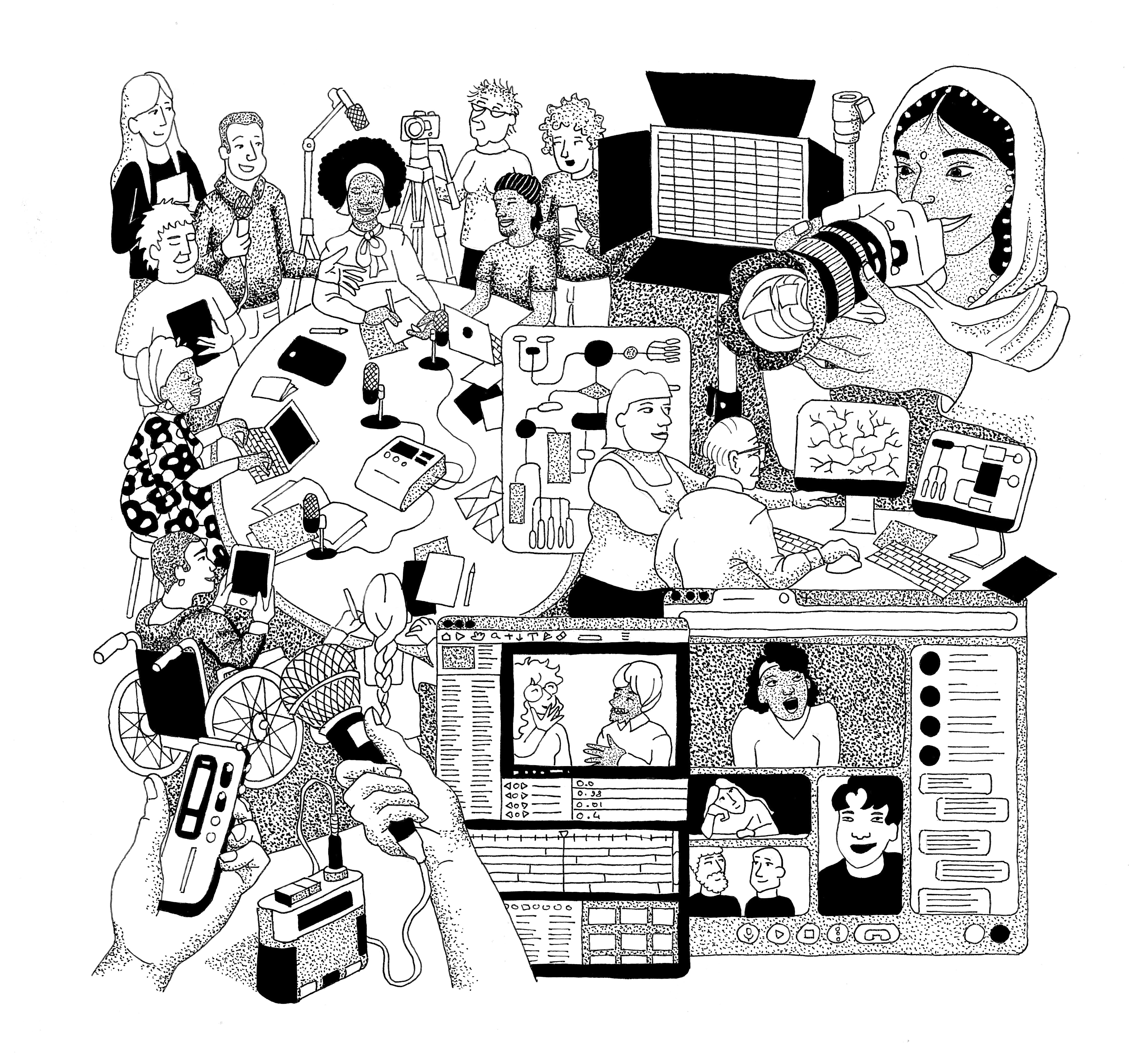
The DelibTech Network is collaborating to:
Guide technological innovation around a critically informed repertoire of deliberative technologies.
Develop principles and protocols for deploying emerging technologies in deliberative processes.
Share information and good practices with one another to encourage mutual learning, the cross-pollination of expertise, and a thriving community of practice.
Disseminate research into the media and other public channels.
Enable strategic collaboration and coordination between network members.
Membership in the network is invite-only. We would like to keep the group size such that everybody knows one another, and that we have a good mix of expertise and geographies. While people can express interest to join, we are not expanding it right away and intend to keep the group small to begin with.
A first virtual convening took place on 23 September 2025 to launch the network, and a first in-person convening is happening on 14 October 2025 in Brussels, to examine ecosystem gaps and to comprehensively map applications. Beyond this, other proposed convenings in the first 12 months include a deep dive into risk mitigation and to provide a space for network members to share core learnings/experiences/challenges from the field.
The University of Sydney and DemocracyNext are excited to announce that we will be collaborating on a new project: “Including the more-than-human in decision making”.
Stories from around the world about worsening climate change, and the deepening degradation of nature are mainstays of news bulletins and weather forecasts. At the same time, high-profile processes like the Paris Agreement and government commitments seem to be failing to make a noticeable mark.
In recent decades, there has been increasing recognition of the need to involve the more-than-human in decision making. Around the world, communities and organisations are taking truly radical actions, not only to protect the planet, but to transform how people relate to the natural world. In this sense, they are doing more than providing hope that the climate, nature and biodiversity crises we are facing may be abated. Rather, they enable us to imagine what our worlds would look like if all animals and the natural world were truly included in the decisions that are shaping how we live.
This way of working has practical implications for decision making which, to be democratic, needs to take seriously the interests of all who are affected.
In this project we will be working together to:
Create an inventory of existing methods, approaches, and their impact, taking a curious and critical lens to understanding this emerging field.
Conduct two original experiments on more-than-human inclusion in decision making. The first experiment will involve adaptation planning in Australia, and the second, a climate or biodiversity citizens’ assembly in Europe in collaboration with the Knowledge Network on Climate Assemblies (KNOCA). The objective is to test how different models of more-than-human inclusion can be put into practice in real world decision-making contexts, and to evaluate their impacts on participants, processes, and decisions.
Support a global community of practice to connect practitioners, and share knowledge and learning across continents. The community of practice will aim to offer those conducting similar experiments in different contexts with a platform for sharing experiences and learning, with a view to supporting and elevating the quality of practice across the field.
We are looking to work with a climate or biodiversity citizens’ assembly taking place in Europe during 2025 / 2026. If you are involved in or know of an assembly taking place that might be interested in partnering with us, please contact Danielle Celermajer.
This project has been generously supported by the V. Kann Rasmussen Foundation.
🐝 Upcoming events
20 October, 13:30 - 15:00 GMT, online
The jury’s in: What Birmingham wants from its museums. Join us for a webinar exploring stories from behind the scenes of the first citizens’ jury in a UK museum. This event is co-hosted by our Chief Strategy and Creative Officer, Lucy Reid, and Charlotte Holmes, Birmingham Museums’ Trust, alongside some of the citizen jurors, Sara Wajid, co-CEO of Birmingham Museums Trust, Mara Livermore and Rowan Harris from Shared Future, Mathew Beckett from River Rea Films and evaluator Isabella Roberts.

15 - 16 October, Brussels, Belgium
The DemNext team will be at the Democracy R&D conference this year. Claudia Chwalisz, Cities Programme Lead, James Macdonald-Nelson, and Senior Advisor Ieva Cesnulaityte will also be running some workshops.
16 - 17 October, Amsterdam, Holland
Lucy Reid and Cities Programme Coordinator, Hannah Terry, will be running a workshop at the World Cities Culture Summit on 17 October. Lucy will also be speaking in the plenary session.
7-10 May 2026, Athens, Greece
Claudia will be speaking at the World Beautiful Business Forum, the most human gathering for the more-than-human world, next year. As the House of Beautiful Business turns ten in 2026, the event will explore how to shape a humanist future.