

Data Centres Need a Social License to Operate
How lessons from citizens' assemblies are highly relevant for the future of AI infrastructure and data centres


Written by Stefaan Verhulst (The GovLab/The DataTank) and Claudia Chwalisz (DemocracyNext), originally published on Verhulst’s Medium platform, 12 May 2026.
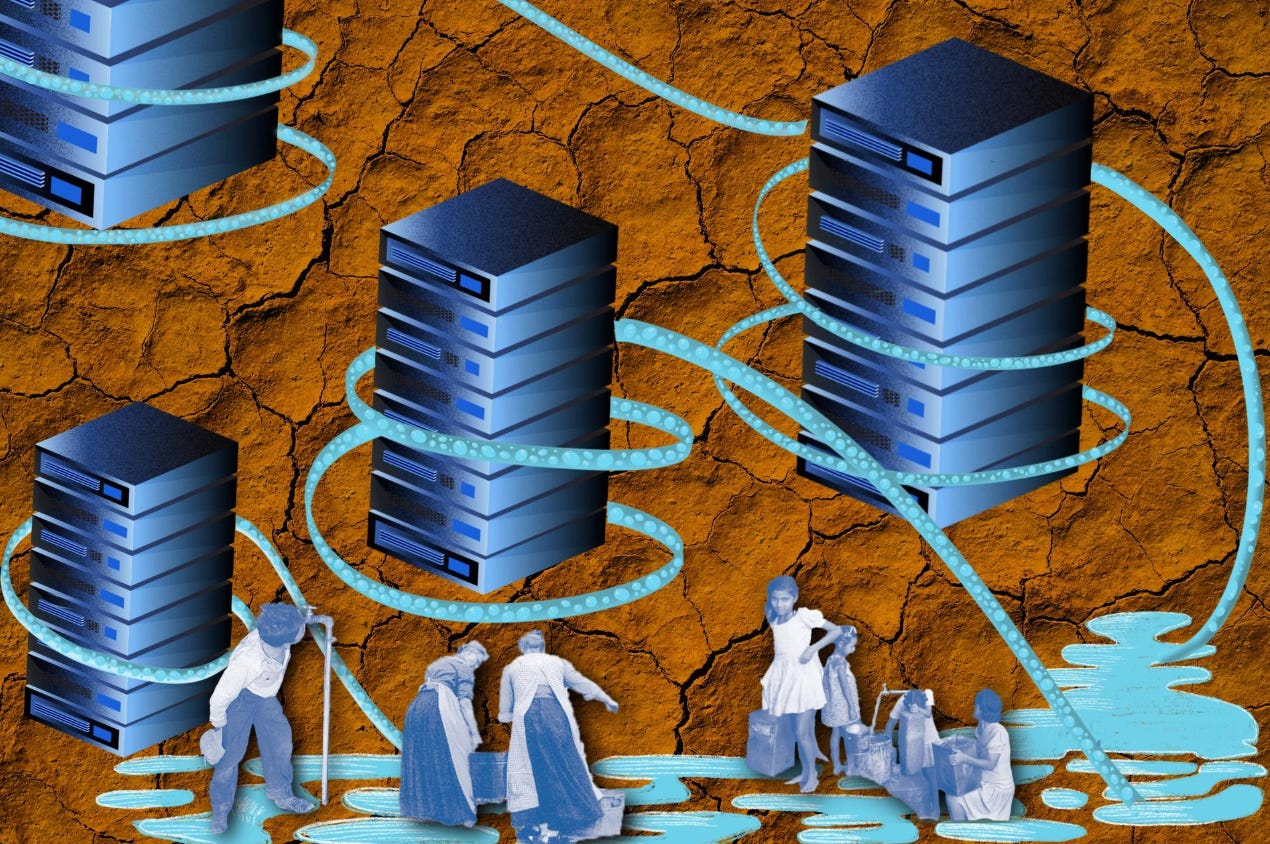
The race to build the infrastructure of AI is accelerating. Across the world, fields, industrial parks, and suburban edges are being transformed into data centres - vast, warehouse-like facilities that power everything from cloud storage to large language models.
For technology companies, this expansion is claimed to be essential. For the communities where these facilities are built, it is becoming increasingly contentious.
Recent reporting in The New York Times, and elsewhere, has captured the growing unease. Residents are questioning the scale of water consumption required to cool servers, the strain on local energy grids, and the transformation of landscapes once defined by entirely different economic and environmental logics. In many cases, the promised benefits - jobs, investment, growth - feel limited when set against the demands these facilities place on shared resources.
What is emerging is not simply a series of local disputes. It is a broader challenge of legitimacy.
There is a concept for this, though it predates the digital economy. In the 1990s, mining and energy companies (often called extractive industries) began to recognise that regulatory approval was no longer sufficient to ensure that projects could proceed smoothly. Communities could - and did - push back against developments that were fully legal but widely perceived as unfair or harmful. The term that emerged to describe what was missing was “a social license to operate”.
A social license is not granted by governments. It is conferred, informally but powerfully, by the people who live with the consequences of a project. It depends on trust, on transparency, and on a sense that the balance between costs and benefits is acceptable. Crucially, it is not static. It can be strengthened over time - or withdrawn.
Data centres are now encountering this reality.
At first glance, they may seem far removed from the extractive industries where the idea of social license originated. They do not dig into the earth or deplete mineral reserves. They process data. They enable services that are widely valued and increasingly indispensable.
But their operations depend on something just as fundamental: access to shared, finite resources. Water to cool equipment. Electricity to power servers. Land to house the facilities themselves. And, perhaps most importantly, the willingness of communities to host infrastructure whose primary benefits often accrue elsewhere.
This last point is becoming harder to ignore. A data centre built in a poor rural county may support global digital services in urban centres, but its immediate impacts - on water and ecological systems, energy demand, health and land use - are intensely local. When those impacts are not matched by visible and meaningful local benefits, questions of fairness quickly arise.
This is where the distinction between legality and legitimacy becomes critical.
A project can meet every regulatory requirement and still lack a social license. Permits can be issued, environmental thresholds satisfied, and yet communities may feel that decisions have been made without them, rather than with them. In such cases, opposition is not an anomaly. It is a predictable response.
The experience of other industries suggests what happens next. Without a social license, projects face delays, legal challenges, and, in some cases, cancellation. More broadly, trust erodes - not only in the companies involved, but in the institutions that approved the projects in the first place.
For data centres, the stakes are particularly high because they underpin so much of the modern economy. The expansion of AI, in particular, depends on a rapid scaling of computational infrastructure. But infrastructure that lacks public legitimacy is inherently fragile.
The question, then, is not whether data centres are necessary, but how they can be developed in ways that are perceived as legitimate, socially acceptable, and, of course, environmentally responsible.
Securing a social license requires a different approach from the one that has often characterised digital infrastructure development. It begins with acknowledging that communities are not simply sites for deployment, but stakeholders with a legitimate interest in how resources are used and decisions are made.
It also requires a more honest accounting of impacts. Water use, energy demand, and land transformation cannot be treated as secondary considerations or technical details. They are central to how projects are experienced on the ground, and therefore to how they are judged.
Most importantly, it requires a shift in how benefits are understood and distributed. When the advantages of data centres are diffuse and global, while the costs are concentrated and local, legitimacy becomes difficult to sustain. Bridging that gap is not straightforward, but ignoring it is no longer an option.
One promising pathway for building such legitimacy is through more participatory forms of governance. Obtaining a social license cannot be reduced to a communications strategy or a one-off consultation meeting. It requires ongoing mechanisms through which communities can meaningfully shape decisions about how data infrastructure is designed, governed, and operated.
Citizens’ assemblies offer one such mechanism. When properly designed, they bring together a group of residents to learn about complex issues, hear from diverse experts and stakeholders, deliberate collectively, and develop informed recommendations. Unlike traditional public hearings - which often reward the loudest voices or occur after major decisions have effectively been made - assemblies create space for informed, sustained, and inclusive dialogue. They can help surface community concerns early, identify trade-offs transparently, and establish a stronger sense of procedural legitimacy.
We have seen the value of this approach firsthand through our work in New York City on responsible data reuse. Through the Data Assembly, which The GovLab convened in partnership with the NYC and Brooklyn libraries, residents from across the city were brought together to deliberate on questions surrounding the reuse of data for public interest purposes (during Covid-19). Participants engaged directly with issues of trust, consent, governance, accountability, and community benefit. Importantly, the process demonstrated that citizens are fully capable of engaging with technically and ethically complex questions when given the time, information, and institutional support to do so.
The lessons from these assemblies are highly relevant for the future of AI infrastructure and data centres. Communities do not simply want to be informed about decisions after the fact. Increasingly, they expect a role in shaping the conditions under which infrastructure is developed, how benefits are shared, what safeguards are put in place, and how long-term impacts are monitored. Citizens’ assemblies can help transform opposition into co-creation - not by guaranteeing consensus, but by ensuring that decisions are seen as fair, transparent, and democratically grounded.
There are early signs that this recalibration is beginning. In some cases, developers are engaging more directly with communities, offering greater transparency about resource use, or exploring ways to align projects with local priorities. But these efforts remain uneven, and they often occur after opposition has already emerged.
The lesson from the history of social license is that timing matters. Legitimacy is far easier to build at the outset than to recover once lost.
Data centres were once easy to overlook - quiet, distant, and largely invisible. That is no longer the case. As their scale and impact grow, so too does the scrutiny they attract.
The digital economy may run on data, but it is anchored in place. And in those places, acceptance cannot be assumed.
It has to be earned.
Stefaan Verhulst is Co-Founder of The GovLab and The Data Tank, and a Research Professor at Tandon School of Engineering, New York University, where he works on advancing collaborative approaches to unlocking data and AI for public interest purposes.
Claudia Chwalisz is Founder and CEO of DemocracyNext, an research and action institute dedicated to strengthening democratic governance through the design and implementation of citizens’ assemblies and other forms of participatory democracy.
🌊 On the radar
Got 10 minutes? Cambridge PhD researcher and DemocracyNext AI Fellow, Sammy McKinney, is running the first global survey on AI use in deliberative mini-publics, and wants to hear from practitioners and researchers: take the survey here.
FIDE are hosting Facilitator Training Programmes, the next in partnership with We Do Democracy, held in September in Copenhagen.
We’ve curated a playlist on Spotify which introduces, via podcasts and interviews, deliberative democracy and citizens’ assemblies. There’s 11 hours worth of knowledge here, so click follow and start listening!
Our friends at the AI & Democracy Foundation have developed a useful (and beautifully designed) resource for those interested in deliberation and technology - the Democratic Capabilities Gap Map.
An inspiring interview on Futurepolis with Richard Young, CivicLex, on why local democracy efforts are hard to scale because “scaling” is the wrong goal:

🗓️ Events
14-16 May, London, UK
Lucy will be attending the afternoon sessions of the MOTH Festival of Ideas, exploring the rights and well-being of humans, nonhumans, and the web of life that sustains us all. If you’re going to be there, let us know!
20 May, online, 17:00-18:00 CEST
Claudia Chwalisz will be speaking at the Mozilla Foundation’s Democracy x AI panel. Join the conversation about what it means to build technology with democratic intent, and interrogate whether that’s even enough.
11 June, online, 16:00-17:30 CEST
Save the date for the launch of two new DemNext reflection pieces on multilingualism in citizens’ assemblies — one by Hugh Pope, author and DemocracyNext International Advisory Council Member about the EU Citizens’ Panel on Intergenerational Fairness, and one by James MacDonald-Nelson and Hannah Terry about the Esch Citizens’ Assembly. These short papers draw on observation and interviews with interpreters, facilitators, technologists, and assembly members.
Please include links for registering for the launch events of the multilingualism pieces.