

Deliberative Muscles & AI
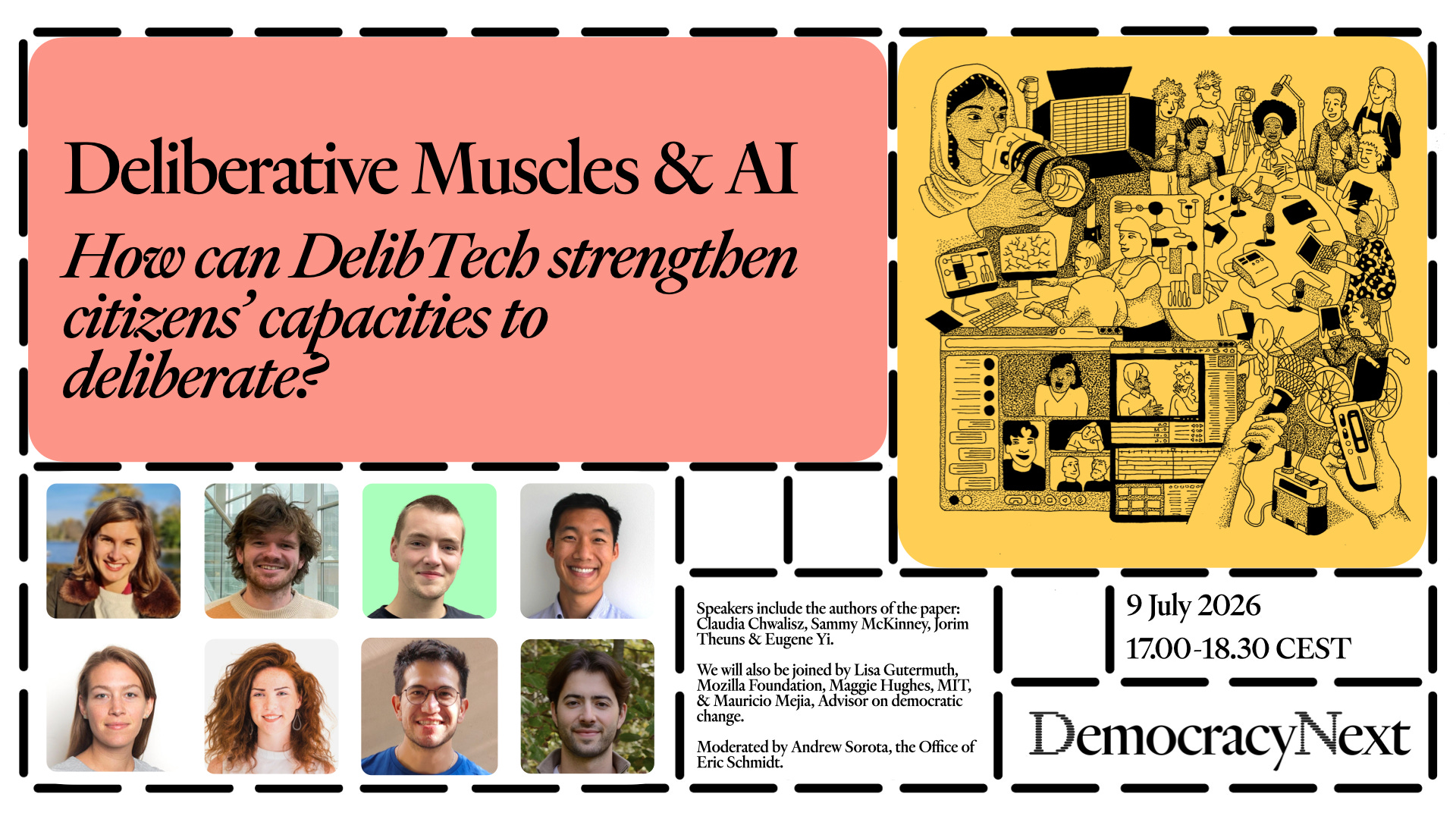
In our latest paper, we ask how can DelibTech strengthen citizens’ capacities to deliberate? Find out on 9 July at 17:00 CEST at the online launch


Democracy is under strain. Polarisation is hardening, trust in institutions is eroding, and global challenges are outpacing the capacity of our political systems to respond.
In this DemocracyNext webinar, we launch Deliberative Muscles and AI, a new paper by Claudia Chwalisz, Sammy McKinney, Jorim Theuns, and Eugene Yi.
The authors argue that deliberative assemblies are not decision-making machines whose sole value lies in the quality of the recommendations. They are spaces in which participants exercise and develop the civic capacities that democracy depends upon. The authors call these deliberative muscles - and a muscle weakens when it isn’t used.
The paper maps seven of them: self-reflection, reasoning, dialogue, vulnerability, collaboration, imagination, and facilitation. For each, they explore where AI integration risks substituting for the muscle, and where it may be able to strengthen it. The key design question is: “does this technology leave people more or less capable of deliberating well?”
This paper is for people with the authority to decide, or responsibility for deciding, how technology is going to be deployed in a deliberative process - commissioners in government and other organisations, as well as democracy practitioners, designers, and facilitators. We are also writing for technologists deciding what to build, for funders deciding what to back, and for scholars mapping a fast-moving field.
What to expect:
Why deliberative assemblies are sites where we exercise and strengthen the capacities that democratic life requires
The seven deliberative muscles, and how technology can help or hinder each
The distinction between complementary and competitive AI uses in deliberative practice
The implications for practitioners, technologists, funders and scholars working at the intersection of AI and deliberative practice.
Speakers:
Claudia Chwalisz, Author, Founder and CEO, DemocracyNext
Claudia has been working on democratic innovation for 15 years, initially sparked by her research on populism, and the extent to which it is driven by people’s disillusionment with the political system, and with a lack of agency to shape the decisions affecting their lives. Claudia was involved in designing the world’s first permanent citizens’ assemblies in Paris, Ostbelgien, and Brussels. Claudia established and led the OECD’s work on innovative citizen participation from 2018-2022, creating the Deliberative Democracy Toolbox, which includes a public database of over 700 examples of Citizens’ Assemblies, the flagship report Catching the Deliberative Wave (2020), standards for implementation (2020), and guidelines for evaluation and institutionalisation of deliberative assemblies (2021), as well guidelines for citizen participation processes (2022). Claudia founded DemocracyNext in 2022.
Sammy McKinney, Author, AI & Deliberation Fellow, DemocracyNext, and PhD Candidate at the University of Cambridge
Sammy is a PhD student in Politics and International Studies at the University of Cambridge. His PhD research critically explores the integration of artificial intelligence into processes of public deliberation, especially citizens’ assemblies. This research expands on his master’s thesis carried out at the University of Edinburgh, which he published in an adapted form in the Journal of Deliberative Democracy. Beyond academia, Sammy has facilitated AI governance courses for BlueDot Impact, co-developed ethical guidelines for AI in public deliberation with deliberAIde, and planned tech-enhanced conservation projects with partners from across the globe through Rainforest Connection.
Jorim Theuns, Author, Co-Founder, Dembrane
Jorim is the CEO and co-founder of Dembrane, a civic tech initiative dedicated to transforming how democratic participation works in everyday life. At the heart of Dembrane’s work is the belief that democracy should be more than a political event every few years, it should be part of how we govern our cities, design public services, and make collective decisions.
Eugene Yi, Author, Impact Research Fellow, DemocracyNext
Eugene Yi is an experienced tech entrepreneur, product and media executive, and policy expert. Previously, he co-founded Cortico to help build tech-enhanced deliberative systems for our democracy. His experiences range from leading Asia policy at Twitter from 2012 to 2016, and he was previously the Head of Product at Hawkfish, a digital technology and data firm founded by Mike Bloomberg. He served in the U.S. Department of Defense and was a U.S. diplomat early in his career. He received his AB and MPA from Princeton University, and is a Visiting Researcher at MIT and a PhD candidate at Oxford University.
Lisa Gutermuth, Senior Program Officer, Mozilla Foundation
Lisa is a senior program officer with the Mozilla Foundation Incubator, where her work focuses on identifying and supporting technologies that give power back to people and communities. She is also a representative member of Green Screen Coalition, which works toward building out the intersection of climate justice and digital rights. She has also been a visiting researcher at the Humboldt Institute for Internet and Society in Berlin, and served on the jury of the German Prototype Fund from 2019-2023. Prior to working with Mozilla, Lisa was a senior program manager at Ranking Digital Rights, and a project coordinator with Tactical Technology Collective, where she focused on digital security, remote sensing, and sustainability.
Maggie Hughes, PhD Candidate, MIT Center for Constructive Communication
Maggie designs technologies and systems informed by the human practices that contribute to a functioning deliberative democracy, such as dialogue and community organising. In her PhD, she explores different methods of data collection, analysis, visualisation, and action that are informed by these practices. Using participatory methods for design research, including co-design and participatory action research, Maggie partners with local community members and organisers in her work. Currently in the Center for Constructive Communication, she works on research related to the Real Talk project for which she co-lead participatory sense-making and now co-designs data analysis processes and visualisations in Boston.
Mauricio Mejía, Advisor on democratic change
Mauricio Mejía is based in Mexico City, where he works at the intersection of democracy, citizen participation, and technology. He collaborates with civil society organisations across Latin America to promote sortition as an alternative to party-based representation and citizens’ assemblies as deliberative models to enrich collective decision making. He advises governments and international organisations and was recently elected to a participatory governance body in Mexico City. Mauricio is a member of international networks including Democracy R&D, People Powered, and Démocratie Ouverte, and he previously coordinated citizen participation at the OECD, worked in French institutions, and taught at Sciences Po Paris.
Moderated by:
Andrew Sorota, Head of Research for the Office of Eric Schmidt
Andrew has worked on the teams of Eric Schmidt and Fareed Zakaria since graduating from Yale with a BA in Political Science and Philosophy in 2022. His main research interests are populism and democratic innovations. He wrote “Why picking citizens at random could be the best way to govern the A.I. revolution” for Fortune Magazine with Hélène Landemore and Audrey Tang.
The webinar will be recorded and shared after the session via our YouTube channel.
🗓️ Events
From Projects to Permanence: Citizens’ Assemblies as New Democratic Institutions in Cities and Regions: Wednesday 15 July, 17:00-18:30 CEST
As our Cities Programme comes to a close, James MacDonald-Nelson and Hannah Terry examine in greater detail the learnings from working with cities and regions to institutionalise citizens’ assemblies - Vilnius (Lithuania), Kerewan (The Gambia), Esch-sur-Alzette (Luxembourg), and Central Oregon (USA).
➡️ On the radar
🎧 Andrew Sorota recently joined The Truth About Bullsh*t podcast hosted by Caleb Zakarin. In ‘AI, Algocracy, and Democracy’s Challenging Road Ahead’, they discuss how to ensure that democracy and individual rights are safeguarded amidst the most transformative technological revolution in more than a century.
💻 In May and June this year, Snohomish County, USA, hosted a civic assembly in which the 29 randomly-selected members deliberated on the subject of AI, and came up with AI policy recommendations.
📄 ‘Governing the Future: Recommendations from the Edinburgh Data and AI Exchange’ is the newest report published by the University of Edinburgh, which brings together proposals on AI skills, national infrastructure, health data governance and democratic oversight.
⚖️ In ‘Stop Shouting. Start Policymaking’, Carl Miller from Demos, argues that political polarisation and conflict around contentious issues can be reframed as a problem of information design rather than irreconcilable values - and that AI tools can help fix that.