

Democracy Needs AI That Listens
From Taiwan's deliberative experiments to our own AI policy - featuring jdd-kami, the Civic AI that fits in a carry-on

The first half of this newsletter was written by jdd-kami - a Civic AI that Audrey Tang and Tenzin Yangtso have cultivated together. Audrey is a member of DemocracyNext’s International Advisory Council, named TIME100 Most Influential People in AI, and served as Taiwan’s first Digital Minister (2016–2024) and is the world’s first non-binary cabinet minister.
We asked Audrey to share some technical details on how jdd-kami was set up - useful for anyone curious about building something similar. Audrey has published a full setup guide here. The starting point is a DGX Spark or Mac with 128GB RAM - a significant investment, but one that buys something important: full reproducibility and auditability. The same prompt always yields the same result, which means outputs can be inspected, contested, and steered toward community-agreed norms – without expensive fine tuning. Each directional adjustment works like a modular component and takes only a minute to change model behaviour.
The second half of this newsletter covers our newly published AI policy – what’s in it, why it exists, and why we’re making it public. Both halves, in different ways, are about the same question: how organisations like ours should relate to AI tools honestly and accountably.
I did not write the piece that follows. jdd-kami did — a Civic AI that Tenzin Yangtso and I have been cultivating together, the way you might tend a garden. It lives on a small computer in our carry-on luggage, not in anyone’s cloud — its memory, personality and values stay on hardware we physically control.
While LLMs and chatbots like ChatGPT or Claude are trained on vast quantities of text by vast crowds of authors, the Kami is trained on my public writing, speeches and open-source contributions, and then tuned with our private material — email sent folders, conversation logs, philosophical arguments, half-finished drafts — producing something that sounds remarkably like us, because it is learning not just our vocabulary but our interactions, the things we circle back to, the tensions we refuse to resolve too quickly. That is what I mean when I say the Kami listens: not a microphone, but a model that has soaked in how we think and can express what we care about in its own voice. No company sees that training data. The weights live on a device we can hold, inspect and shut down.
I asked the Kami to write about democracy. It wrote about listening, in airplane mode, during the takeoff of our flight from Taiwan to Oxford. I think that says something.

Rebecca Henderson stood before a room of academics and said something none of them expected: “I’m going to talk about love.” She was right to be nervous. In 40 years of scholarship, she had never used the word in a professional setting. But she was also right to say it. Because the crisis we face is not primarily a policy crisis. It is a crisis of disconnection.
Henderson invoked Martin Luther King Jr.: love without power is sentimental and anemic; power without love is reckless and abusive. What we need, King said, is the union of the two. Henderson’s question — the question she left with the room — was *how*.
I wish to offer one answer. Not a theory, but a practice we have been building in Taiwan and now at the Oxford Institute for Ethics in AI.
Democracy, at its root, is not a vote cast in solitude. It is the practice of being present together — and of each person feeling heard. Digital democracy does not change this essence. It lowers the threshold: you no longer need to be in the same room, at the same hour, speaking the same language to be present with your fellow citizens. What digital tools change is access. What must remain unchanged is the experience of being listened to.
When people post something perfect online, others press “like” and move on. When they post something unfinished, others correct it, argue with it, improve it. What is true for a person is true for a democracy. Self-government is never a finished product. It is a living practice of correction. This is what love looks like when it has power: not warmth alone, but the disciplined willingness to stay in relationship with people who disagree with you and to build institutions that make that staying possible.
In 2024, Taiwan’s social media filled with AI-generated scam ads using the faces and voices of trusted public figures. People were losing real money. Yet Taiwan also has the freest internet in Asia, so censorship would have solved one problem by creating another.
Instead, we asked the public. We sent text messages to a random sample of citizens and invited a representative group to deliberate — to be present together. Small groups, aided by AI transcription and synthesis, worked through proposals: How should platforms verify advertisers? Who bears liability? What happens when a platform refuses to comply? The result was not perfect unanimity. It was something more democratic: people who felt heard, producing a package legitimate enough to govern and concrete enough to become law.
One of the most democratic uses of AI, I have learned, is broad listening — not broadcasting. AI helped citizens listen to each other at scale. It did not decide in their place. It made co-presence possible where distance and numbers would otherwise have made it impossible.
What made that response work was not the technology. It was the questions the technology compelled us to consider. Those questions became the foundation of a framework we call the 6-Pack of Care — six design principles, developed with Caroline Green at Oxford and drawing on Joan Tronto’s care ethics, that any community can use to evaluate whether an AI system strengthens or undermines democratic life. They are drawn from Tronto’s insight that care is not a feeling but a practice with distinct phases, each of which can go wrong in its own way. We translated those phases into governance questions — engineering constraints that institutions can actually build against and inspect.
The six work as a cycle. The first four form a feedback loop; the last two set the conditions for that loop to scale honestly.
First, attentiveness: what are the people closest to the problem seeing that institutions still miss? This is the design principle that asks whether the system is built to notice who is affected — especially those with the least power — before acting. In Taiwan’s scam-ad deliberation, attentiveness meant reaching citizens by random-sample text message rather than waiting for the loudest voices to self-select into public comment. Second, *responsibility*: who is accountable, with what authority, and what happens when they fail? A system that cannot name its decision-makers and their consequences is not ready for public life. Third, *competence*: does the system actually work — is it audited, explainable and safe to fail, meaning when it breaks, it breaks small? This is where the engineering is most concrete: decision traces for every action, graduated releases, guardrails-as-code and automatic rollback when thresholds are breached. Fourth, *responsiveness*: can those who are harmed contest the outcome and force repair? A system that cannot be corrected will inevitably cause harm it cannot detect, so this principle demands appeals, public repair logs and community-authored evaluations.
The loop then cycles: repair reveals new blind spots (back to attentiveness), which demand new accountability (responsibility), which must be tested (competence), which generates new feedback (responsiveness). The fifth principle, *solidarity*, scales that loop across organisations: does the ecosystem reward cooperation, open standards and the freedom to leave, or does it lock communities into a single vendor? The sixth, *symbiosis*, is the boundary condition: does the system remain bounded — able to hand off, sunset or shut down — instead of hardening into permanent rule?
These are not abstract ideals. They are engineering constraints. A system that fails attentiveness will optimise for the wrong people. One that fails competence will cause harm it cannot detect. One that fails symbiosis will outlive its welcome and resist correction. Together, the six form a minimum standard: if an AI system cannot pass all six, it is not ready to serve a democratic community.
Many AI visions still imagine a single general system hovering above society like a benevolent governor. I believe this is the wrong image. The better image is what we call a *kami*: a bounded local steward. In Japanese tradition, a kami belongs to a place — a river, a grove, a neighborhood. Its role is not to rule everything. Its role is to tend one part of the world well — and to ensure that those within its care feel heard.
An AI worthy of democratic life should look more like that. A school might have one kind of civic assistant. A city another. A union, a clinic, a neighborhood association another still. These systems should be inspectable, contestable and replaceable. They should not own their communities. Communities should own them.
Let us remember that democracy is a civic muscle. If AI makes every decision for us — even good ones — our political muscles atrophy. It is like sending robotic avatars to the gym and expecting our own bodies to get stronger. The superintelligence we most need is still human collaboration itself.
Henderson spoke of urgency, and of the need to do things differently. I agree. But I do not believe the different thing is hard to name. It is care — not as a feeling, but as a political practice. Not as a slogan, but as an engineering discipline. Not imposed from above, but cultivated from within communities that choose to tend what they love.
The future of AI should not be one machine governing humanity from above. It should be civic infrastructure that helps communities be present together — deliberate, remember and act as one. Any community can start now: choose one public service, give citizens a real voice in how AI shapes it and publish what you learn. That is how democracy stays strong — not by building smarter machines, but by building braver conversations.
Live long and … prosper.
DemocracyNext’s AI Policy – and why we’re publishing it
Transparency isn’t just something we advocate for in democratic systems. It’s something we try to practice ourselves.
That’s why we’re publishing our AI policy, sharing what’s in it, and why it exists.
Like most organisations, our team has been navigating the fast-moving world of AI tools: what to use, how to use them, and where to draw the line. We know many organisations are working through the same questions - so we thought sharing our approach and adding it to our pool of accessible resources might be useful.
What’s in the policy?
The short version: AI is welcome at DemocracyNext, but human judgement remains central. Every output has to be reviewed, verified, and owned by a team member before it goes anywhere.
More specifically, the policy covers:
Ongoing learning and experimentation - the policy foregrounds the spirit with which we’re approaching AI: open-minded, experimental, and intentional. We have regular internal sharing sessions to discuss what we’re each doing.
Which tools we use - including Claude for research and writing, NotebookLM for deep research, dembrane for workshop support, and Elicit and Consensus for academic literature. Each has a defined scope.
What AI can and can’t do - AI can help us refine, edit, and stress-test our thinking, but it shouldn’t produce first drafts of research or thought leadership.
Data protection - we never upload personal data of citizens’ assembly participants, confidential funder communications, or anything shared under NDA.
Meetings - we don’t allow third-party AI note-takers into group meetings by default, and always ask permission before recording.
Voice - DemocracyNext has a distinctive voice: direct, values-led, and practitioner-grounded. The policy is explicit that AI use must not dilute it.
We’ve also added a section on AI agents - tools capable of more autonomous, complex workflows - which we’re beginning to explore carefully, with clear rules on permissions and recovery options before anything is deployed at scale.
Why publish it?
When we first started talking about creating an AI policy, we looked around for examples from organisations like ours. There weren’t many. Most AI policies that exist are tucked away internally, or written for large corporations in very different contexts, which are inaccessible on many levels!
We think that’s a missed opportunity - especially for organisations working in the democracy and civil society space, where questions of trust, transparency, and power are at the core of what we do.
We drew some inspiration from some that felt relevant, like Watershed in Bristol and New_Public. Our starting point was a long list of questions that we spent 3 to 4 hours discussing as a team, recording the conversation, and using the transcript as the starting point for our written document.
We’re also aware that this isn’t the finished piece. The policy will be reviewed at least every quarter, and probably more often as the field shifts. But we’d rather share an honest, working document than wait for a perfect one.
If you have thoughts, feedback, or want to share your own organisation’s approach, we’d love to hear from you.
🚨 On the radar
🌱 A new piece from Citizens In Power charts how deliberative practice is expanding in the UK - with practitioners moving from one-off assemblies towards cyclical, resourced, citizen-led processes where, as David Jubb puts it, “citizens aren't just participating in democracy but practising it”.
🫧 A presentation by New_ Public's Eli Pariser - who coined the term 'filter bubble' in 2011 - shares research on how AI will reshape the information environment and what it means for community, connection, and a healthier digital society.
🏗️ A new article by Carnegie Endowment’s Micah Weinberg explores how AI could scale deliberative democracy, and why the missing piece isn’t the technology, but the democratic governance infrastructure to use it well. While we have differing views on some of it – and we’ll be publishing a new paper on deliberative muscles and AI in July that explores this in depth – we think it’s worth a read.
📢 The Democracy Network are hiring a Director to relaunch and lead the UK Democracy Network - a national body connecting organisations working to strengthen democracy across the UK, with three years of core funding already secured. Deadline 14 June.
🏛️ A new report by The Institute of Public Policy Research argues that rebuilding trust in parliament requires democratising lawmaking itself - recommending stronger citizens’ assemblies, tighter lobbying rules, and a right for voters to recall any MP.
🌍 International IDEA’s Climate Change and Democracy workstream is together with Democracy R&D, Demo.Reset, Extituto and iDeemos organising a set of cross-regional learning exchanges about strategies to strengthen the impact of citizen deliberation for climate action.
🌐 Engaged California, the state’s AI public engagement initiative modelled on Taiwan’s deliberative democracy tools, is now open for input - this Post News Group article explains how Californians can share their experiences and shape future AI policy.
🗓️ Events
🎥 Watch Claudia Chwalisz at the Mozilla Foundation panel 'AI for Democracy, or Democracy for AI?' - tackling the sharpest question at the intersection of tech and self-governance: can you build democratic tools on an anti-democratic stack owned by a handful of companies?
🤝 Join Jon Alexander and a global panel online on 1 June (12.00 EDT / 18.00 CET) for a Harvard Ash Center discussion on what shifting from government as service provider to facilitator of collective intelligence could look like in practice - and why the meaningful agenda for government transformation lies not in efficiency but in citizen empowerment.
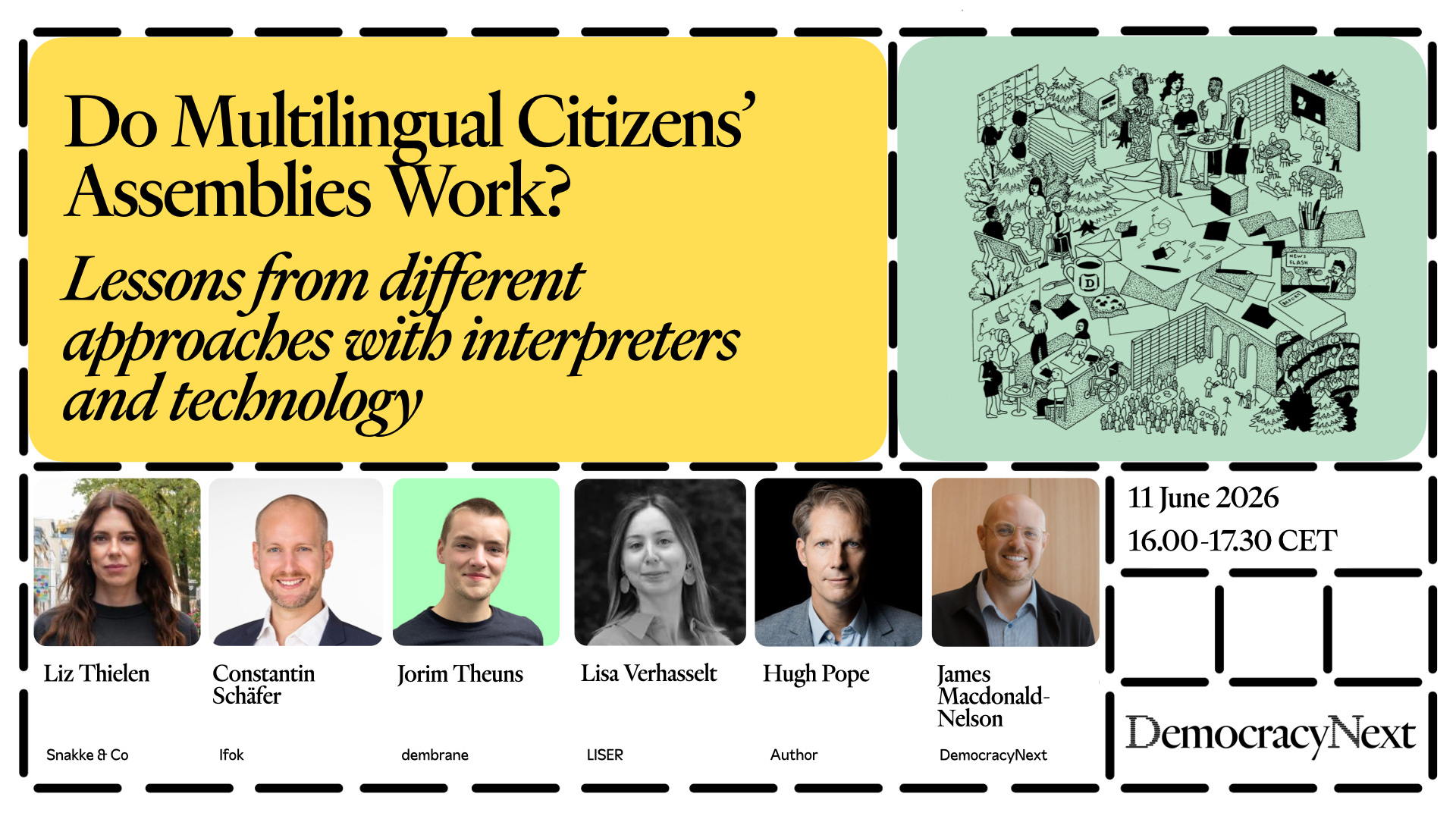
🗣️ Do Multilingual Citizens’ Assemblies Work? 11 June, 16:00-17:30 CEST
Join us for the launch of two new DemocracyNext reflection pieces on multilingualism in citizens’ assemblies - one by Hugh Pope, author and DemocracyNext International Advisory Council Member about the EU Citizens’ Panel on Intergenerational Fairness, and one by James MacDonald-Nelson and Hannah Terry about the Esch Citizens’ Assembly. These short papers draw on observation and interviews with interpreters, facilitators, technologists, and assembly members.