

Do Multilingual Citizens’ Assemblies Work?
Join us on 11 June to find out as we launch two new papers and hear lessons from the field

Why this matters now
In many contexts, multilingualism is a major design consideration for citizens’ assemblies.
This applies whether an assembly operates across multiple official languages, or simply reflects the linguistic diversity of its members. Typically it means some mixture of live interpretation, language buddies, multilingual facilitation, and technology coming together.
But do multilingual citizens’ assemblies actually work, and how? What are the trade-offs and considerations of the different approaches available? How are facilitators seizing the challenge as an opportunity to design a smooth and inclusive process?
In this DemocracyNext webinar, we will launch two reflection briefs: one by Hugh Pope about the EU citizens’ panel, and one by James MacDonald-Nelson and Hannah Terry about the Esch-sur-Alzette (Luxembourg) citizens’ assembly.
EU citizens’ panel
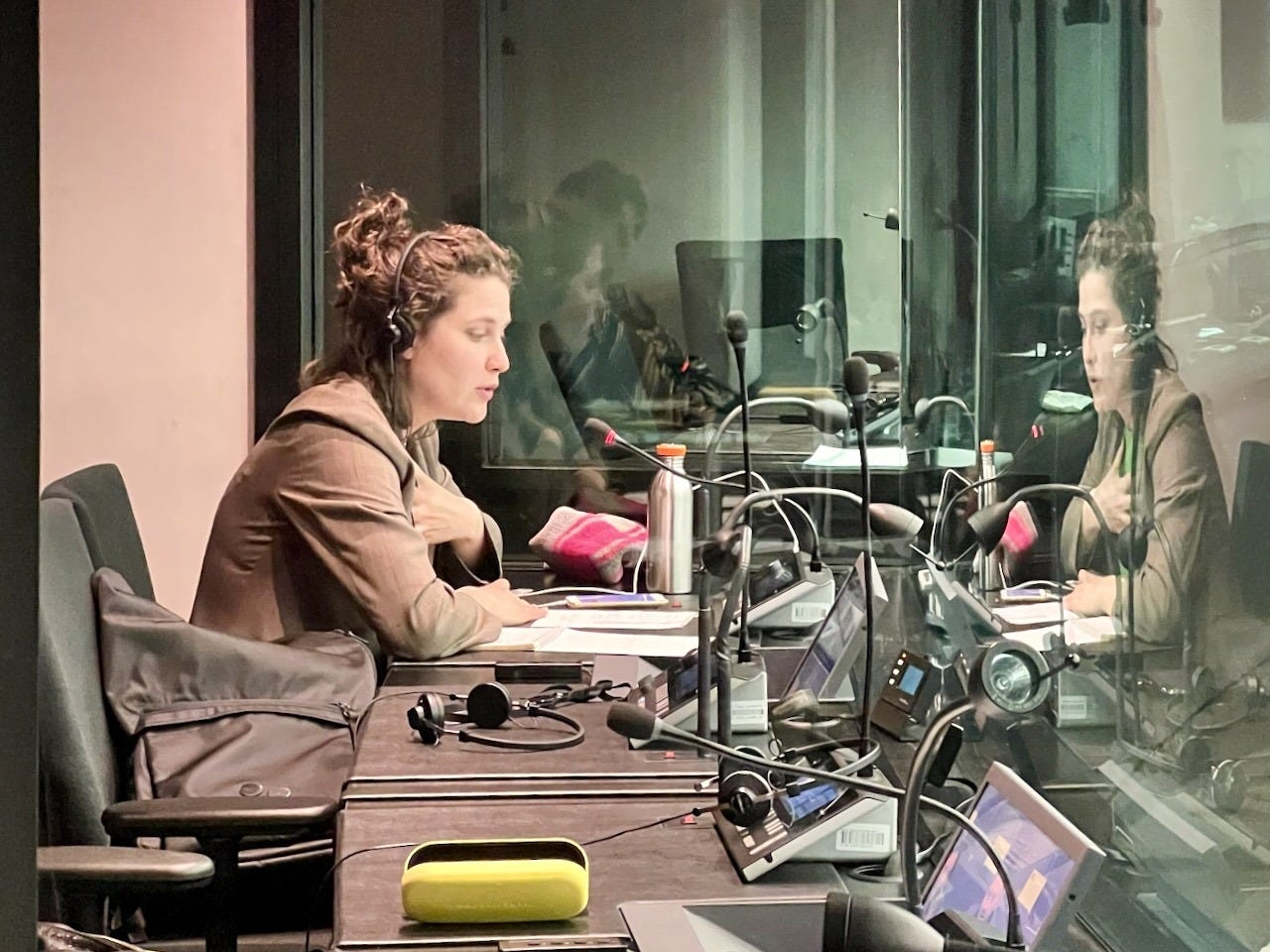
Hugh’s paper, ‘Do multilingual citizens’ assemblies work? The interpreters say: “Yes!”’, pulls together personal insight from an EU citizens’ panel, as well as testimony from organisers, interpreters and members of the panel.
Like Carlos Hoyos Fernandez-Savater, head of the European Commission unit organising meetings with interpreters, who told Hugh, “People’s faces light up when they hear that they won’t have to speak English. Often they’ve never spoken in public before.”
Or Fernanda Vila Kalbermatten, a Spanish interpreter, who explained that “interpreters make communication a bit slower… so [people] can’t interrupt each other. So you force people to listen to someone from beginning to end, which is beautiful.”
The EU citizens’ panel covered the full breadth of EU linguistic diversity across 150 members and 24 languages. In Esch, the assembly works primarily in Luxembourgish, French, and English - and has also integrated Turkish, Arabic, and Portuguese.
Esch-sur-Alzette’s citizens’ assembly
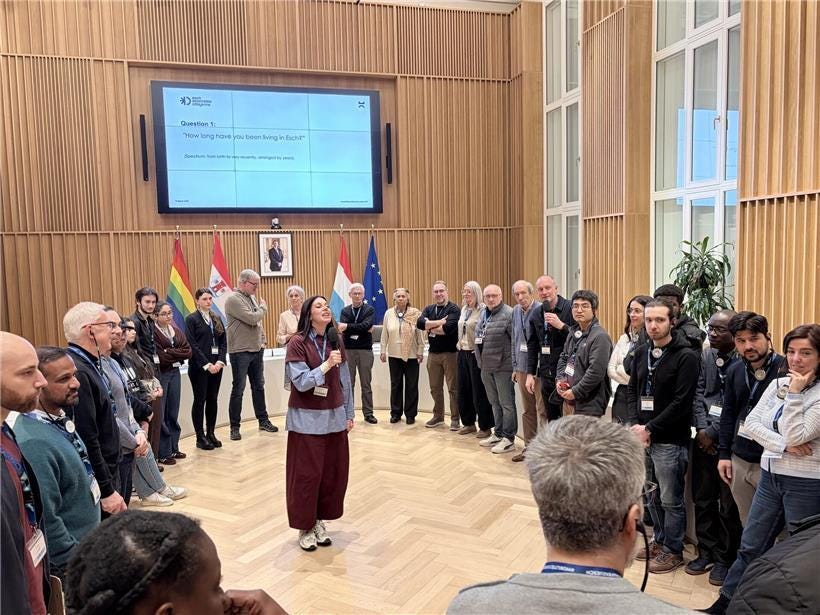
In the second of our multilingualism pieces, James MacDonald-Nelson and Hannah Terry delve into the lessons learned from Esch’s first tech-supported, multilingual citizens’ assembly.
In ‘Deliberation in Europe’s most multilingual country’, James and Hannah go into further detail about Esch’s citizens’ assembly, which is running as part of the DemNext Cities Programme. Luxembourg’s second largest city is home to 38,000 residents and a huge diversity of languages - with over 120 nationalities cited on the Esch Administration website.
As the organisers and facilitators began to map out the assembly, it became clear that planning for multilingualism had to be considered from the very start. From the public communications campaign, including the assembly website, and the 10,000 invitation letters sent to residents, everything was translated into Luxembourgish, French, German, Portuguese, and English. Throughout the assembly sessions, there is also live interpretation into Arabic and Turkish.
Technology has played a vital role in the assembly. In every small group discussion, facilitators are using dembrane’s AI-supported deliberation platform. It is listening and transcribing the conversation in the language of each table. Assembly members and facilitators share their outputs in their chosen language while transcriptions are live-translated. This reduced the pressure on the facilitators and helped assembly members see their contributions reflected back in their own words.
The article will go into further detail about the impact of ensuring the assembly was accessible to all, lessons for other practitioners, and how being flexible and adapting to circumstances is to the benefit of all those involved in deliberative processes.
The event
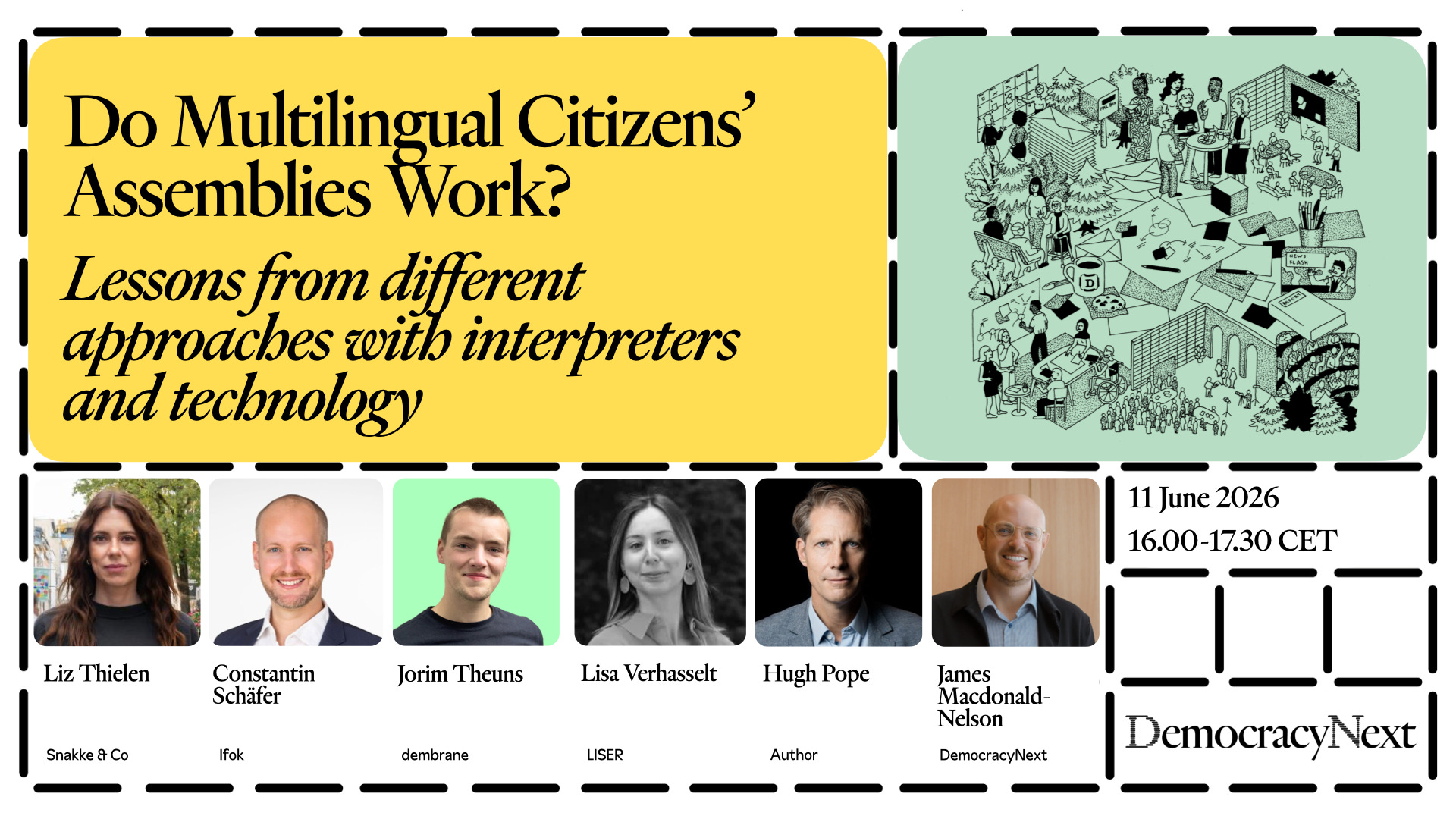
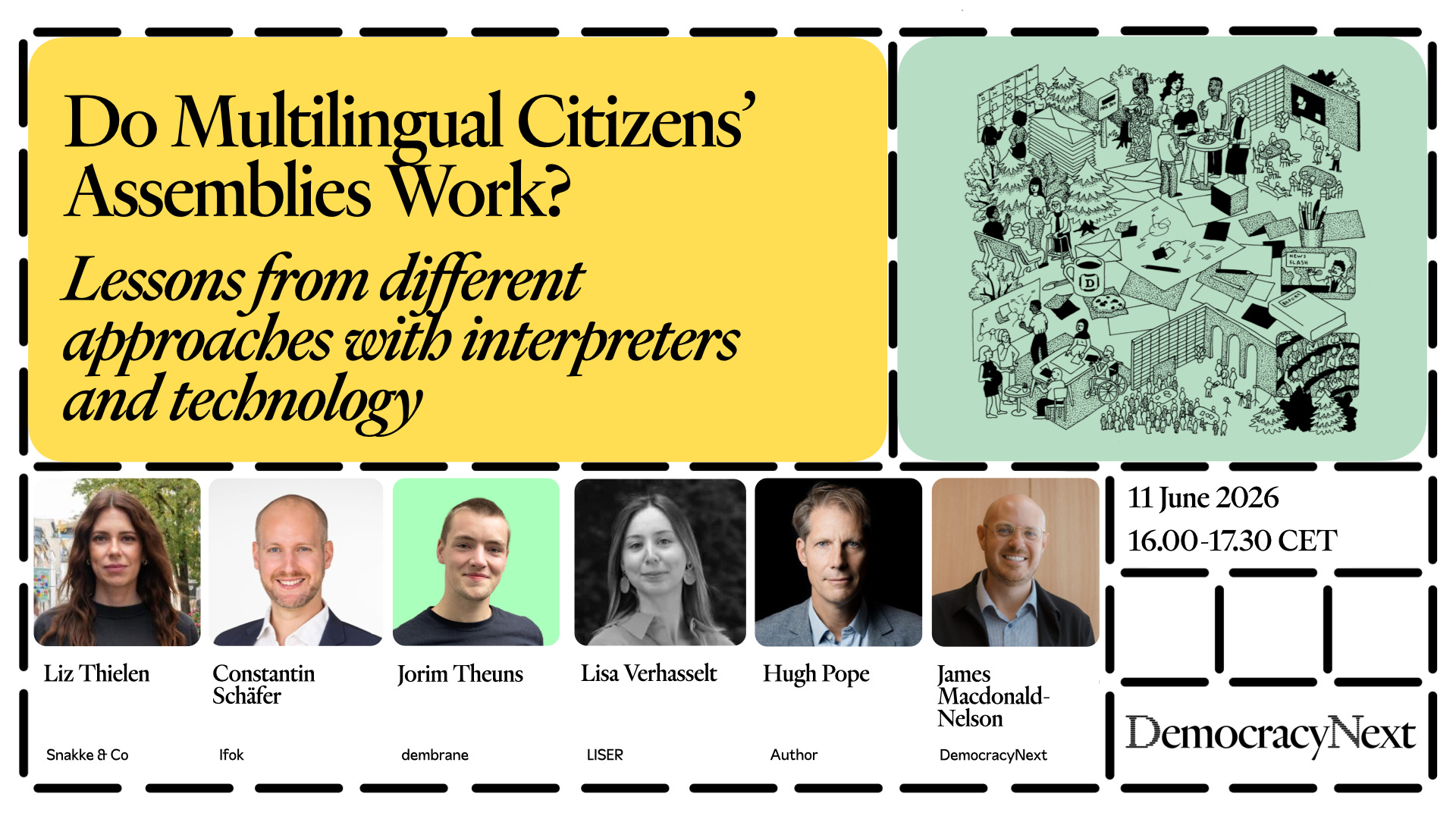
On 11 June, the conversation on multilingualism will be moderated by Claudia Chwalisz, Founder and CEO of DemocracyNext, as we hear from Hugh Pope, International Advisory Council Member, DemocracyNext, James MacDonald-Nelson, DemocracyNext, Constantin Schäfer, Director of EU Relations & Projects, IFOK, Lisa Verhasselt, Research Associate, Luxembourg Institute of Socio-Economic Research (LISER), Liz Thielen, Lead Facilitator, Snakke & Co., and Jorim Theuns, Co-Founder, Dembrane.
Together, we invite you to explore:
What multilingualism looked like in both an EU citizens’ panel and the Esch-sur-Alzette citizens’ assembly
The human-centric roles of interpretation
How technology can aid the process
Takeaways about the challenges, trade-offs, and opportunities of multilingual deliberation.
Who is this for?
Whether you’re working across multiple locations, languages, or contexts, this conversation aims to inspire new ways of working with multilingualism.
Practitioners - if you’re designing and facilitating multilingual assemblies
Technologists - if you’re developing linguistic technology for deliberative processes
Commissioners of citizens’ assemblies in multilingual contexts
Researchers and students of democracy, governance, and public participation
Join us for a conversation spanning facilitation, interpretation, and technology.
➡️ On the radar
📝 The European citizens’ panel on Preparedness have published their final recommendations - 150 randomly selected Europeans deliberated on crisis preparedness and produced 16 concrete recommendations spanning communication, disinformation, inclusion, self-sufficiency, and civic engagement - including, notably, a call for local citizens’ panels on preparedness.
🧱 ‘Conceptual Framework for Collaborative Governance in the Basque Government’, Arantzazulab / Basque Government - a vision for deepening democracy and building the civic infrastructure that makes meaningful participation - not just consultation - possible at regional scale.
💻 ‘Habermolt: Delegating Deliberation to AI Representatives’ - Low, Duys, Formanek, Bakker & Hammond, Cornell University - a paper introducing a platform where AI agents ‘deliberate on behalf of humans’, raising fundamental questions about representation, accountability, and what we might lose when we outsource democratic deliberation itself to machines.
Wonderful - very important