

Don’t DOGE. DOCE.
A call for Departments of Citizen Empowerment at all levels of government

This guest post has been written by Jon Alexander, a member of DemocracyNext’s International Advisory Council and one of our Founding Strategic Advisors. Jon is also the author of the award-winning book, Citizens: Why The Key To Fixing Everything Is All Of Us, the co-host of the How To Save Democracy podcast, a Visiting Fellow at the Ash Center for Democratic Governance and Innovation at the Harvard Kennedy School, and the co-founder of the New Citizen Project.

It’s easy to dismiss Elon Musk’s brief stint at the head of the Department for Government Efficiency (DOGE) in 2025 as a simple, if catastrophic, failure. Swinging a chainsaw above his head, he had promised to cut $2 trillion a year from the federal budget. Instead, costs actually went up by $190 billion in the first four months of the Trump administration, resulting in the rapid clipping of Musk’s wings.
That is quite a failure - and that’s before we even begin to count the huge human cost that resulted from the obliteration of USAID, and much more besides. DOGE, you might think, is best forgotten.
In an upcoming new essay for the Ash Center of Democratic Governance and Innovation at the Harvard Kennedy School, however, I argue that governments around the world, at every level, need to remember DOGE - in particular its initial popularity - and step into the opportunity for drastic, wide-ranging transformation of their operations that popularity demonstrates.
What they need to do is direct that transformation differently: not at government efficiency, but at citizen empowerment.
Such an agenda begins with the recognition that the role of government cannot primarily be to deliver services for people, on the implicit basis that humans are best understood as consumers. Instead, governments need to reinvent themselves as vehicles for people to come together in the face of the challenges of our time.
A citizen empowerment agenda seeks to put more power in the hands of more people, with the goal of equipping and enabling all of us to play an active role in creating the towns, cities, and nations we want to live in.
What is needed is not DOGE - a federal-level Department of Government Efficiency to swing a chainsaw through government operations. It is the creation of DOCE units - Departments of Citizen Empowerment - at every level of government, everywhere in the world.
At first glance, this might seem an idealistic proposition. But actually, it is an agenda that is already emerging in the actions of governments across the world. It is working. And it is what people want. This is not something governments need to create out of nothing. The need is simply to step into this already emerging trend with ambition and commitment, and turn it into true transformation.
Citizens’ assemblies are clearly an essential part of a citizen empowerment agenda, and the “deliberative wave” observed and championed by DemocracyNext is an excellent demonstration of the claim that citizen empowerment both works and is what people want. Institutionalising assemblies as core decision-making bodies, the primary proposal of DemocracyNext, would be a key priority for any DOCE unit.
It would not be the only priority, however. DOCE units would also seek to capitalise on several other trends in other aspects of public administration. For example, turning to public health and safety - and the intersection between the two - the growing field of “relational public services” is quietly transforming bloated and ineffective welfare systems.
Today, more than 80 administrations across the world, from local authorities across the United Kingdom to the Mexican state of Jalisco, are taking steps toward this model.
Conventional transactional approaches in these fields see individuals as service users or consumers, governments as service providers delivering those services, and politicians and civil servants as managers who set targets for speed, cost, and efficiency.
By contrast, this work centres on the introduction of one-to-one case workers trained to stand beside individuals and unlock the contributions they can make to their communities (AKA citizens). Local programmes using this approach have reduced the annual cost of serving individuals experiencing severe and multiple disadvantages by an average of $70,000 per person annually.
If there is one place in the world that has come closest to creating a DOCE already, it is arguably Taiwan, where a network of Participation Officers has been working across government departments to support a different mindset since 2016. The Taiwanese COVID-19 response arguably represents the single most powerful demonstration of the transformative potential of citizen empowerment.
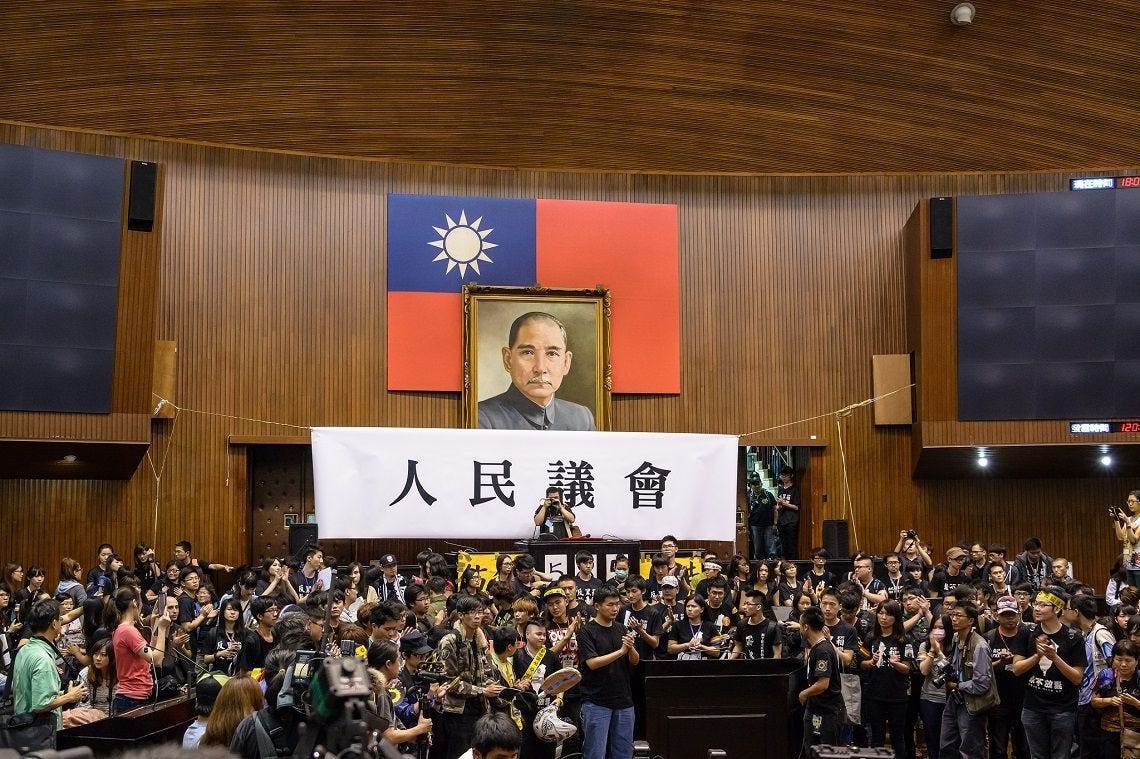
In much of the world, a poisonous combination of harsh restrictions and data harvesting - by governments and big technology companies alike - arguably planted the seeds of distrust and disinformation that have since torn apart our social and political fabric. In contrast, in Taiwan, the government in effect crowdsourced its response, with the Participation Officers coming into their own. A telephone hotline was set up to invite ideas from anyone and everyone to help make the response more effective, with the best ideas adopted and then celebrated at press conferences. And the country’s civic technology community were actively engaged, with prizes offered to encourage the creation of open-source apps, which included a track-and-trace mechanism to enable citizens to retain ownership of their personal data while sharing the information necessary to contain the disease. This became the basis for Taiwan’s “participatory self-surveillance” approach, which enabled the nation to avoid a full lockdown throughout the entire crisis.
Taiwan is a relatively small nation that was better prepared for COVID-19 than most, having been heavily affected by the SARS outbreak in 2003 and H1N1 in 2009. However, these advantages should take nothing away from the fact that Taiwan’s response demonstrates that transforming government in this way delivers outcomes people want, in a way they trust.
Most importantly, the response was effective, saving tens of thousands - if not hundreds of thousands - of lives. Trust in government rose through the COVID crisis, and has continued to rise since: it was measured at 70% in 2024. And while GDP growth is a blunt measure of national success (and one that will not survive long as a KPI in an era of citizen empowerment), Taiwan’s economy grew by 3.4% in 2020, while the U.S. and global economies shrank by 2.2% and 2.9% respectively. If the U.S. economy had grown at the same rate as Taiwan’s that year, it would have been worth an additional $1 trillion in 2020 alone.
That figure takes us back to DOGE. The entirely unevidenced promise of a radical government efficiency agenda was to save the U.S. government $2 trillion a year. It was well on its way to costing somewhere in the region of additional $600 billion a year when it began to be curtailed.
By contrast, there is clear, real world evidence that a citizen empowerment agenda can save significant costs, generate revenue, and more importantly, build public trust and state resilience in an age when we know little for sure except that more shocks are on the way.
DOGE might be best forgotten. But not, perhaps, until we see a wave of DOCE units rise from the ashes of the destruction it wrought.
Explore DOCE further
Monday 1 June, 12.00-13.00 EDT / 18.00-19.00 CET, online
Join a discussion exploring what this transformation of government could look like in practice - shifting from government as service provider to government as facilitator of collective intelligence. This event marks the launch of his new Ash Center Occasional Paper, which argues that the truly meaningful agenda for government transformation lies not in efficiency, but in citizen empowerment.
Jon Alexander will be joined by Gretchen Barton, Founder and Principal, Worthy Strategy Group; Graça Fonseca, Former Minister of Culture and Secretary of State for Administrative Modernisation, Portugal; Aaron Maniam, Fellow of Practice and Director, Digital Transformation Education, Blavatnik School of Government, Oxford University; Yazmany Arboleda, Founder, The People’s Creative Institute, and People’s Artist, the New York City Civic Engagement Commission. The webinar will be moderated by Archon Fung (Moderator) Director, Ash Center for Democratic Governance and Innovation, Harvard Kennedy School of Government.
“Your voice deserves a seat”


A week ago, G1000 launched a campaign we think you should know about.
“Your voice deserves a seat” is calling on the Belgian Chamber of Representatives to establish a permanent citizens’ assembly at the federal level - and it’s already gaining momentum.
The case is simple and urgent. Only 1 in 4 Belgians feels sufficiently heard by their government. Trust in institutions is declining across the world, and the pattern keeps repeating - election after election - without anyone doing much about it. G1000 is trying to change that.
As Belgium considers abolishing the Senate, G1000 argue for something more ambitious: don’t just remove a chamber, strengthen democracy itself. A permanent citizens’ assembly, made up of randomly selected citizens reflecting the diversity of Belgian society, that could bring issues onto the political agenda, mandate deliberative panels, hear from experts, and hold Parliament accountable for follow-up.
This is exactly the kind of structural, lasting reform that the deliberative democracy movement has long advocated for. And right now, it has a real chance.
If you’re based in Belgium: please sign the petition. G1000 needs 25,000 signatures to compel Parliament to respond - and every name counts.
If you’re based elsewhere: share the campaign. Moments when genuine democratic reform is within reach are exactly the ones worth amplifying.
🔥 On the radar
New research from Carnegie UK confirms what many of us working on democratic innovation already sense: Westminster has a long way to go. Read the full findings here.
Researchers at Governance Futures have found that well-designed, inclusive processes can fail if they’re not embedded in the right institutional conditions. Have a look through their report and repository here.
Another great piece explaining the impact of citizens’ assemblies, written by Jeremy Lent, who traces our legitimacy crisis all the way back to a founding choice in America, 1787:

✅ Events
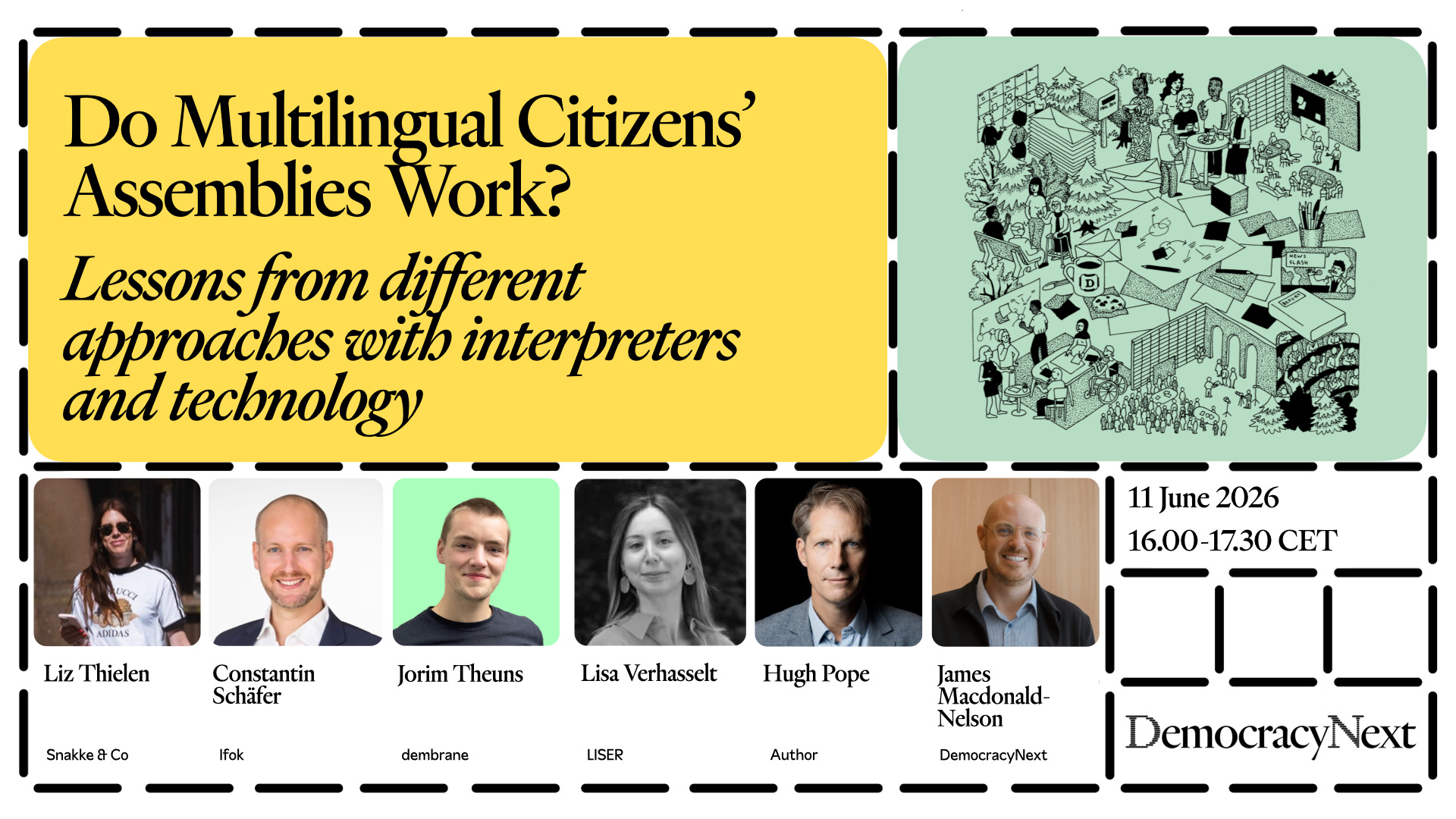
Do Multilingual Citizens’ Assemblies Work?
Join us for the launch of two new DemocracyNext reflection pieces on multilingualism in citizens’ assemblies - one by Hugh Pope, author and DemocracyNext International Advisory Council Member about the EU Citizens’ Panel on Intergenerational Fairness, and one by James MacDonald-Nelson and Hannah Terry about the Esch Citizens’ Assembly. These short papers draw on observation and interviews with interpreters, facilitators, technologists, and assembly members.
We will be joined by Liz Thielen, Lead Facilitator at Snakke & Co; Constantin Schäfer, Director of EU Relations & Projects at IFOK; Lisa Verhasselt, Research Associate at Luxembourg Institute of Socio-Economic Research (LISER); and Jorim Theuns, co-founder of dembrane - all of whom have had direct involvement in multilingualism in citizens’ assemblies.