

Introducing Katcha: An African Democratic Innovation Network
What happens when practitioners and researchers from across Africa come together to reflect on democratic innovation rooted in local knowledge

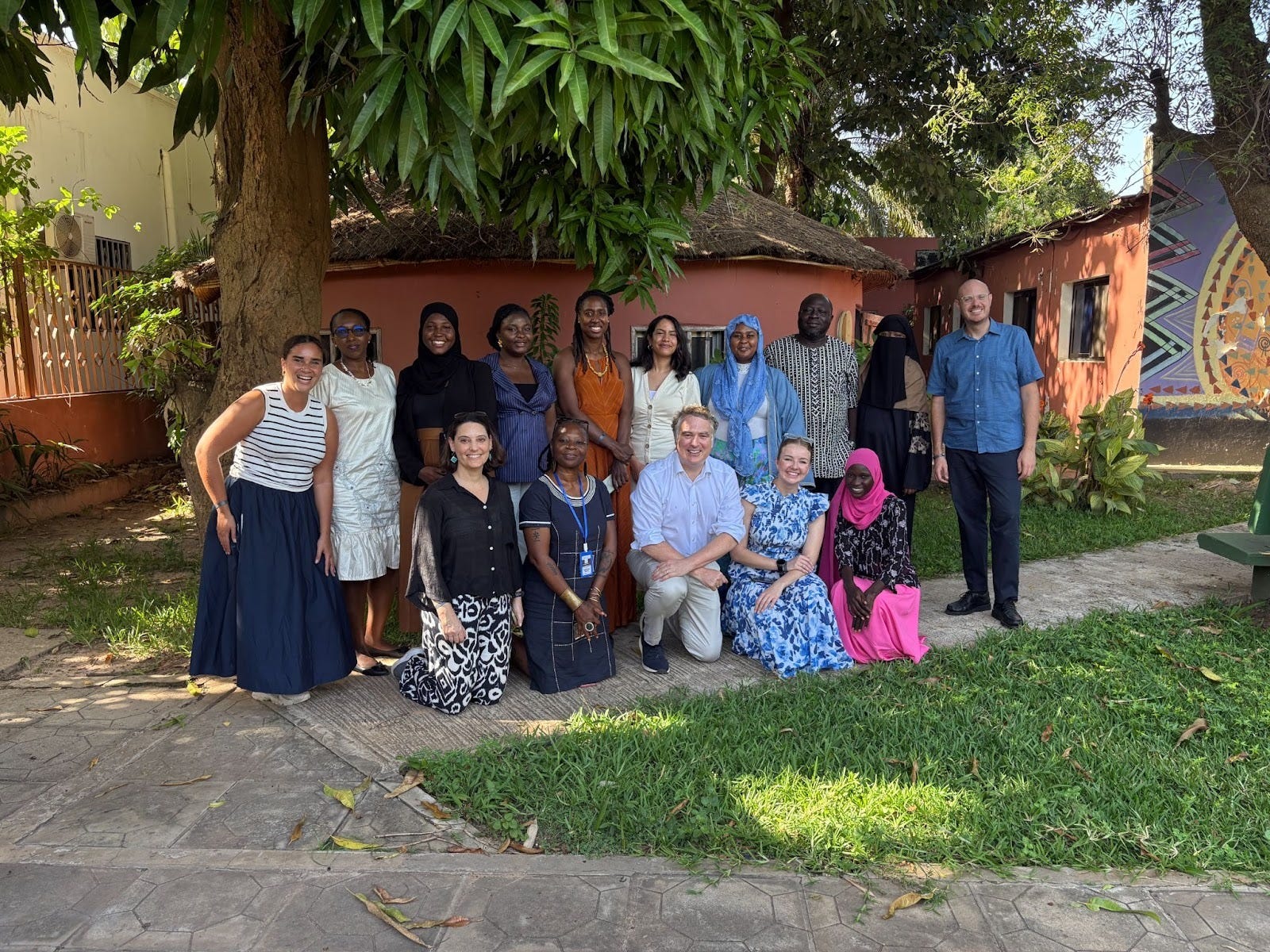
In October 2025, DemocracyNext hosted a remarkable group of facilitators, researchers, civil society actors, and funders in Banjul, The Gambia. They joined to compare experiences and confront a shared challenge:
What does deliberative democracy look like when it is rooted in African contexts, knowledge systems, and lived realities?
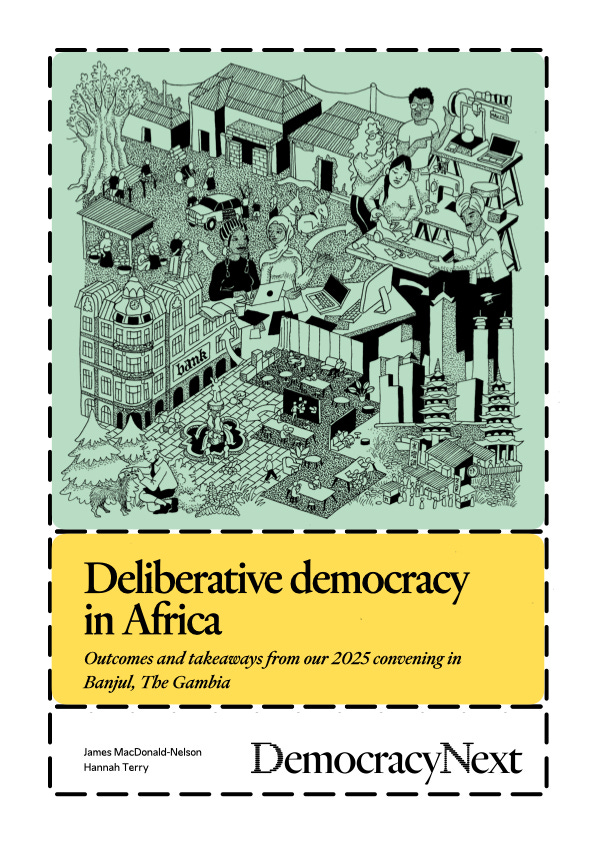
Today, we’re pleased to share a new report capturing the outcomes, insights, and future directions that emerged from those two days together.
Why this convening mattered
Across Africa, communities have long practised collective decision making grounded in dialogue, accountability, and inclusion. Increasingly, practitioners are building on these foundations through new deliberative formats, including climate assemblies and locally driven governance forums.
Yet many practitioners told us they were working in isolation, often unaware of parallel efforts, struggling to contextualise guidelines and draw learnings from examples which are eurocentric.
This convening emerged from our Cities Programme work in The Gambia, where alongside The Great Green Wall Frontline Initiative, we supported the design of the North Bank Region citizens’ assembly. As connections multiplied, a clear need surfaced: space to learn from each other, build trust, and support the African-led field of democratic innovation.
With support from the National Endowment for Democracy, we helped open a space for this convening in Banjul.
What we did together


Over two days, participants shared case studies, highlighting examples of democratic innovation from across Africa and reflected on the practical challenges of inclusion, power, political buy-in, and sustainability.
Conversations focused on how deliberative processes can build on existing traditions, while identifying who is missing from this emerging ecosystem and what long-term collaboration could look like.
We also shared early findings from our upcoming comparative study of African citizens’ assemblies, led by Rorisang Lekalake and Stephen Buchanan-Clarke, launching on 12 March 2026.
Learning from practice: Case studies across the continent
Participants brought lived experience from assemblies and deliberative forums in:
Nigeria, ongoing - Yiaga Africa’s People’s Assemblies across 11 states
Malawi, 2022 - the Salima Citizens’ Assembly on managing Constituency Development Funds
Nairobi, 2025 - a youth-centred Cityzens’ Assembly on air quality
The Gambia, 2025 - the North Bank Region Citizens’ Assembly on climate resilience
Cape Town, 2026 - an upcoming climate assembly designed outside formal municipal commissioning.
Despite their differences, these experiences revealed shared insights: deliberation works best when it is locally grounded, carefully facilitated, and meaningfully connected to decision-making power.
As one member from the Fanta (Kerewan) assembly reflected:
“If I had the power to relay this message to the relevant authorities to empower us, I would be happy.”
Introducing Katcha: An African Democratic Innovation Network
One of the most exciting outcomes of the convening was a proposal to seed a pan-African network for democratic innovation.
The network is provisionally named Katcha, proposed by Gambian facilitators Satang Dumbuya and Cherno Gaye, it is the Mandinka word for deliberation.
Katcha aims to:
Connect practitioners, researchers, funders, and policymakers
Share tools, methods, and evaluations
Support experimentation across different political and cultural contexts
Build sustainable, African-led democratic infrastructure
The network will be led by convening attendees from the School of Collective Intelligence (UM6P in Morocco), Fatima Zamba and Lex Paulson, in collaboration with Priscilla Ciesay from Wave Gambia and Fiona Anciano from The Politics and Urban Governance Research Group at The University of the Western Cape in South Africa.
What comes next
The report outlines eight pathways forward:
Develop hybrid models that bridge traditional and modern deliberation
Create an Africa-focused citizens’ assembly implementation toolkit
Build multi-level engagement strategies
Establish an African network for democratic innovation (Katcha)
Experiment with assemblies commissioned by different stakeholders
Develop strategic communication frameworks
Create feedback loops between process and impact
Test technology appropriately
What began in Banjul is ongoing, and its direction will be shaped by the people who carry it forward. If you’re a practitioner, funder, researcher, or organisation working on democratic innovation in Africa, we’d love to connect. Join the Katcha Community by dropping us a message below.
Deliberative democracy in Africa is not about importing models - it’s about building on practices that already exist, rooting innovations in local contexts, and ensuring processes are driven by communities themselves. It’s also about learning from each other across the continent, sharing lessons between African cities and countries experimenting with these approaches.
📑 Deliberative democracy in Africa: Research paper launch
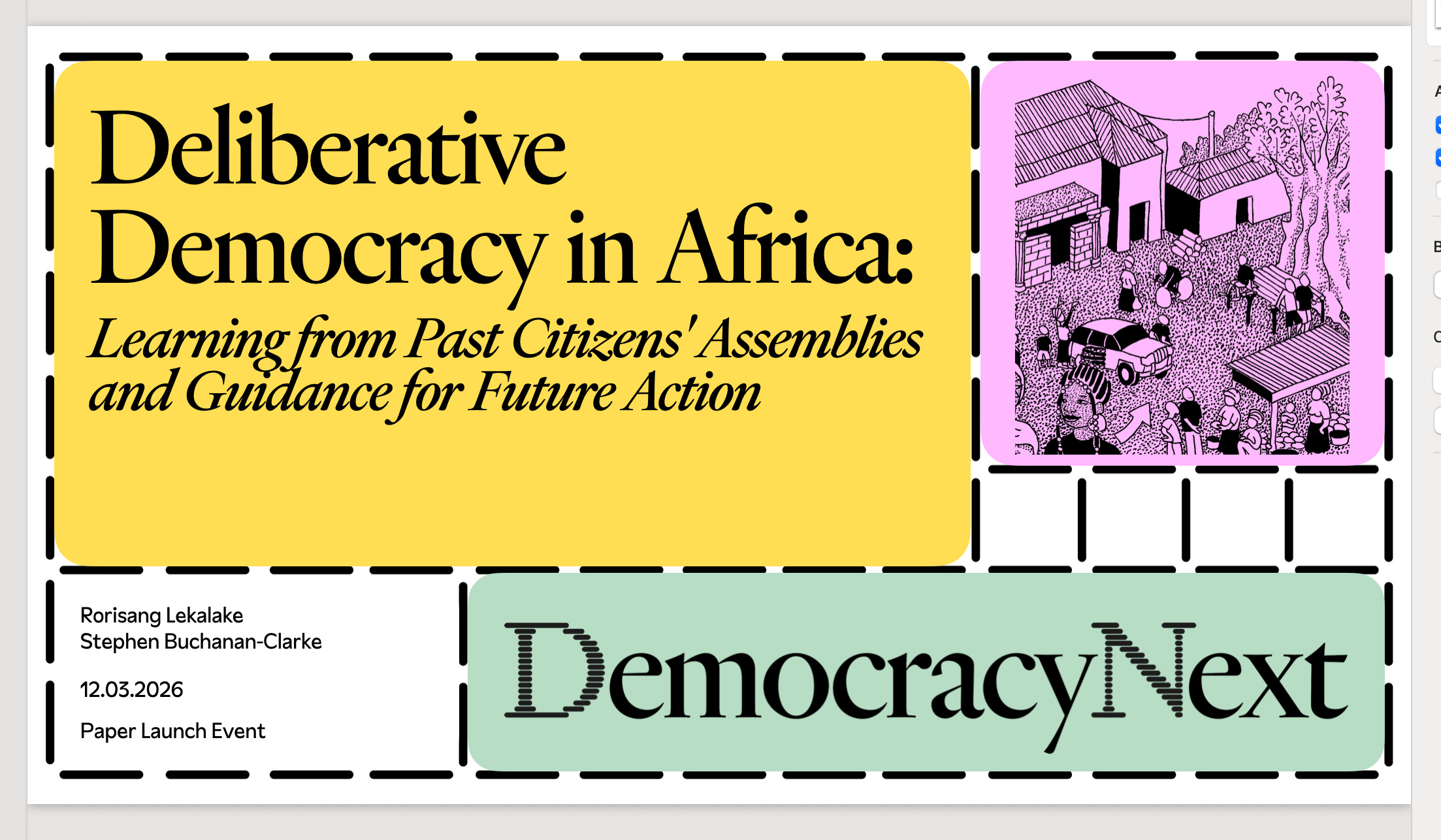
We’re also pleased to announce the release of a new DemocracyNext research paper, Deliberative democracy in Africa, by Rorisang Lekalake and Stephen Buchanan-Clarke, launching with a live event and discussion on 12 March.
Drawing on case studies from Mali, Malawi, and The Gambia, Rorisang and Stephen explore how citizens’ assemblies can build on Africa’s rich deliberative traditions while responding to contemporary governance challenges.
“Deliberative democracy’s focus on inclusive governance is not a foreign import, but builds on deeply rooted principles and practices in many parts of the continent.”
To mark the launch, we’ll be hosting a public webinar with the authors, Eveline Rodrigues, Kira Alberts, and Satang Dumbaya on 12 March - sign up to join the conversation and hear directly from the researchers.
⏰ Events
25 February, online
In 2019, Belgium’s German-speaking Community launched the Ostbelgien Model: the first permanent Citizens’ Council giving randomly selected citizens real decision-making powers. Since then, it has inspired similar initiatives across Europe, including Paris. Researchers at ISPOLE UCLouvain have studied the model from the start. Join them, as well as from the organisers who continue to run and refine the process, for an online workshop on 25 February 14:00–17:00 CET.
26 February, online
From January to September 2025, 175 randomly selected citizens from across The Netherlands took part in the country’s largest-ever climate assembly, deliberating on how to eat, consume, and travel in more climate-friendly ways. The process stood out for its scale, its resilience amid political upheaval, and its innovative, co-created evidence base. Join the KNOCA Learning Call on the Dutch Citizens’ Assembly on Climate (Nationaal Burgerberaad Klimaat) on 26 February, 15:00 – 16:30 CET, to explore key lessons for constructive and inclusive climate dialogue.
7-10 May, Athens, Greece
Claudia will be speaking at the World Beautiful Business Forum, the most human gathering for the more-than-human world, in various legs of the AI Democracy Marathon. DemocracyNext is proud to be a partner to the Forum. We hope to see many of you there!
📡 On the radar
➡️ ‘Democracy After Empire’, highlights George M. Carew’s argument that liberal democracy’s assumptions don’t fit postcolonial African histories, and that deliberative democratic practices rooted in local contexts offer a more credible path to political legitimacy.
➡️ In a letter to The Reformer, David Gartenstein defends Brattleboro’s open town meeting as a vital form of deliberative democracy, arguing it strengthens collective decision-making and accountability in contrast to the more limiting Australian ballot system.
➡️ In the LA Progressive, this piece argues that participatory democracy in the U.S. is struggling because public life and shared civic spaces have diminished, making it harder for ordinary people to gather, deliberate, and engage meaningfully in democratic practice.
➡️ Professor Lawrence Lessig joins On With Kara Swisher to discuss how to curb “dark money” in U.S. politics, explaining why reducing the influence of Super PACs and unaccountable funding is key to strengthening democratic processes - and pointing to citizens’ assemblies as a promising tool for restoring public trust and democratic legitimacy.
➡️ Naeema Zarif argues that treating institutions as living systems rather than static machines can help us rebuild democratic structures that are adaptive, human-centred, and truly responsive to community needs.
No big deal. We've had "KAPTCHA" in Australia for decades.
:-D