

Join the Conversation: Do Multilingual Citizens’ Assemblies Work?
Explore two new essays on the opportunities & challenges of linguistic diversity!

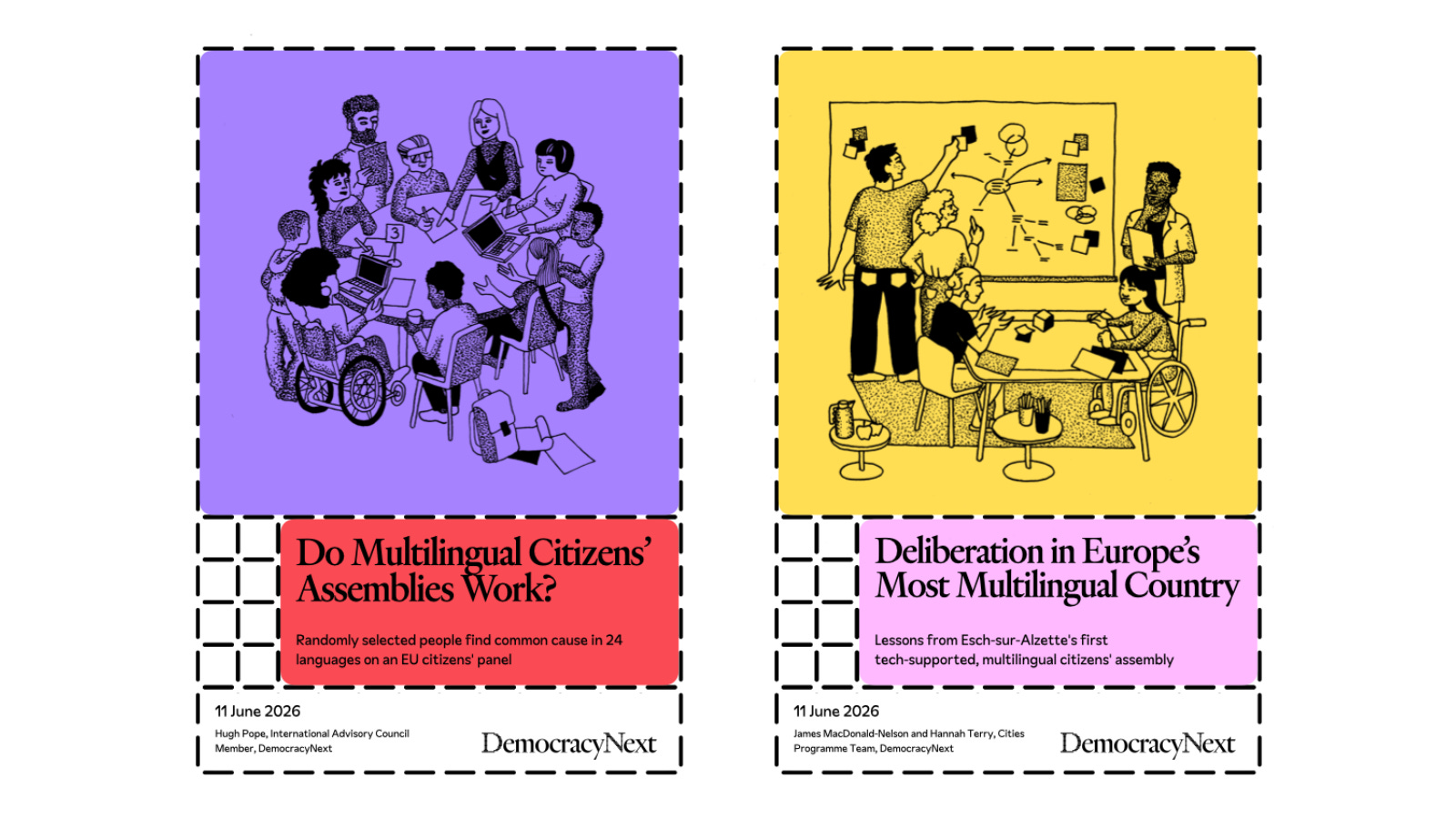
In many contexts, multilingualism is a major design consideration for citizens’ assemblies.
This applies whether an assembly operates across multiple official languages, or simply reflects and accommodates the linguistic diversity of its members. Typically it means some mixture of live interpretation, language buddies, multilingual facilitation, and technology coming together.
But do multilingual citizens’ assemblies actually work, and how?
What are the trade-offs and considerations of the different approaches available?
How are facilitators seizing the challenge as an opportunity to design a smooth and inclusive process?
These questions, and more, have been explored in two new DemNext essays, released today:
Do Multilingual Citizens’ Assemblies Work? by Hugh Pope.
Deliberation in Europe’s Most Multilingual Country, by James MacDonald-Nelson and Hannah Terry.
Below, you’ll find a sneak preview from these reflection essays, as well as a reminder to join us for our live event at 16:00 CEST today, 11 June, to hear directly from the authors and those involved in multilingual citizens’ assemblies.
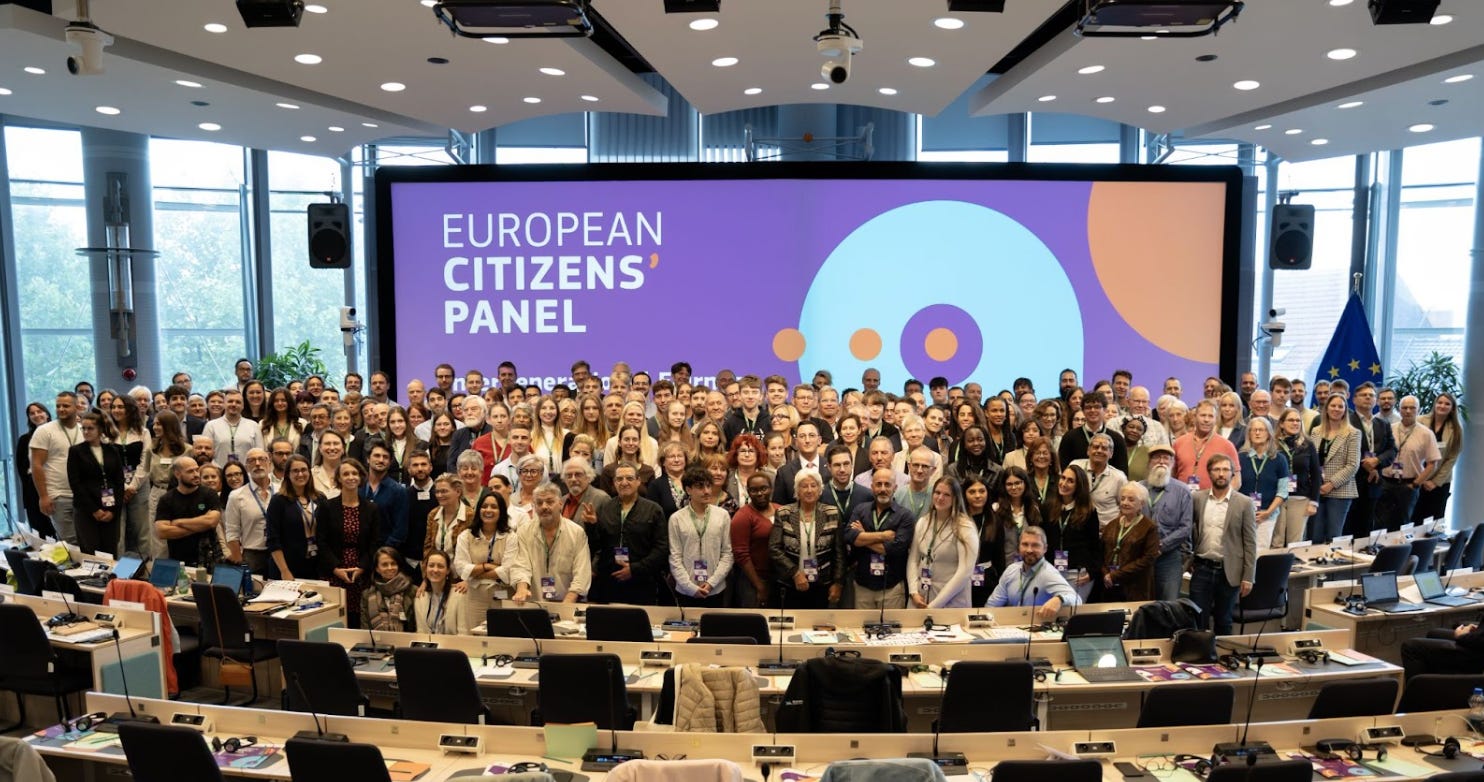
24 languages on an EU citizens’ panel
“I put on my headphones and a miracle happened. A calm, conversational interpretation into English streamed into my ears. The same was happening for everyone in the room, with a choice of 24 languages to tune in to.” - Hugh Pope
EU panels set new standards on how good results can be achieved with high-grade interpretation – in all the organisation’s 24 official languages – and the use of artificial intelligence for the multilingual, real-time work of building up policy recommendations.
“I was very surprised that people from so many different countries and ages and looks can have so much in common,” said one citizen spokesperson at the final plenary of the European citizens’ panel on Intergenerational Fairness. “And I have made friends that I am going to cherish.”
Time will tell if the recommendations of the citizens’ panel have as much influence on the future of Europe as EU officials promised, designed, and hoped for. But there was no doubt it had an impact, both on citizens and, more surprisingly, on the EU officials involved.
“This is why I learned to be an interpreter. This is the most fulfilling experience, to feel like we made communication possible, and that we made citizens realise that they are much more similar than they expect,“ said Vila Kalbermatten, the Spanish interpreter. “Many people don’t know anyone from Finland, or Malta. They don’t have an idea about how they think. Then all of a sudden, because both of them come from a rural area, they smile and it’s so beautiful. They’re like: ‘oh, this is what happens to me as well.’ Such moments make these days so worth it.”
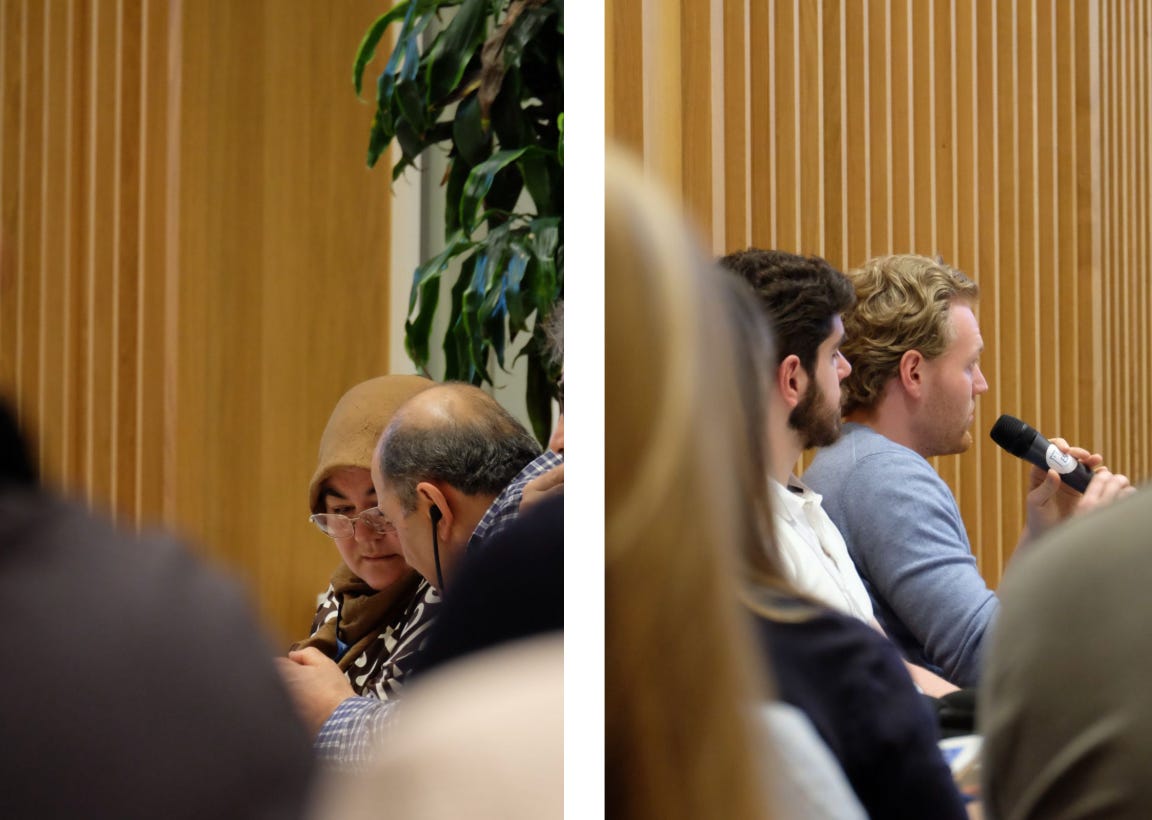
A multilingual, tech-enhanced citizens’ assembly
Even though it was impossible to predict exactly which languages would need to be integrated into the Esch citizens’ assembly process, linguistic diversity was seen as a strength, not a challenge to be avoided. Linguistic diversity, when embraced as a design principle from the start rather than accommodated as an afterthought, can produce inclusive and high-quality deliberative outcomes. That choice shaped everything that followed: who showed up; how people deliberated, and the recommendations they drafted.
“Most people choose comfort over new experiences,” Liz Thielen, Snake & Co., observed, not as a criticism, but as a design constraint to consider. Within each language group, assembly members were often diverse in other ways. The group speaking Luxembourgish, for instance, included some of the youngest and eldest assembly members, representing a diversity in generations. A Turkish-speaking member whose husband provided interpretation remained in French speaking groups, but brought the perspective of a newcomer to Luxembourg to the discussions. Diversity within language groups, Thielen points out, matters as much as diversity between them.
Esch isn’t the first, and won’t be the last, to grapple with the question of how to make deliberation work across multiple languages. But it does offer something rare - evidence that linguistic diversity, when treated as a design principle rather than a logistical headache, can produce a more inclusive assembly.
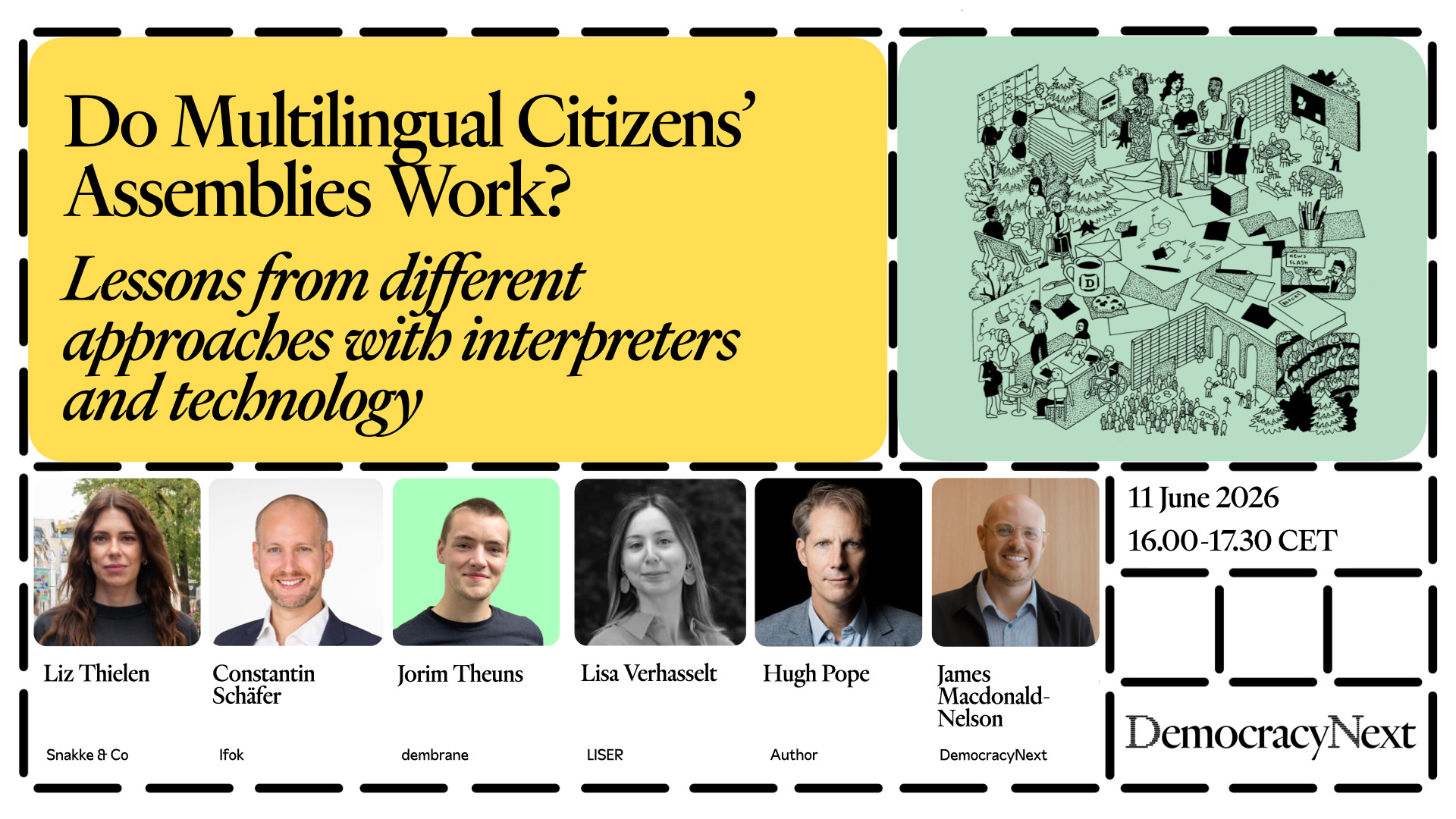
We’re also hosting a live webinar at 16:00 CEST today, 11 June, to discuss the European citizens’ panel and Esch’s citizens’ assemblies. Joining us are the authors, along with;
Constantin Schäfer, Director of EU Relations & Projects, IFOK
Lisa Verhasselt, Research Associate, Luxembourg Institute of Socio-Economic Research (LISER)
Liz Thielen, Lead Facilitator, Snakke & Co.
Jorim Theuns, Co-Founder, Dembrane.
The session will be moderated by Claudia Chwalisz, Founder & CEO, DemocracyNext.
➡️ On the radar
🫶 Roger Berkowitz has published, ‘Friction Is A Civic Virtue’, arguing that in an age of AI-generated ease and deepfakes, attention is the civic faculty we most need to protect - and that friction, far from being a flaw, is the condition of genuine human judgement.
🇺🇸 For our American readers, FrameWorks Institute has published ‘From Protecting the Status Quo to a Vision for Change’, which offers a strategic roadmap for advocates and communicators working to bolster democratic resilience in an era of rising authoritarianism.
🏴 Last month, the Welsh Government released ‘Evidence Review: Mainstreaming participatory and deliberative democracy in Wales’, detailing the state of democratic innovation in Wales and evidence-based recommendations to strengthen participatory and deliberative governance.
🤝 In ‘The Deliberative Wave Reaches American Shores - What Comes Next?’, Dr Paul Zeitz explores how everyday Americans, gathered by lottery and bound by love, are building the next form of self-government.
🗓️ Save the date(s)!
Next month, DemocracyNext will be publishing two new papers, and we invite you to join us online for discussions around them:
9 July, 17:00-18:30 CEST - Online
How can deliberative technology strengthen citizens’ democratic capacities to deliberate? This is the question authors Claudia Chwalisz, Sammy McKinney, Jorim Theuns, and Eugene Yi have been considering in their latest paper: “Deliberative Muscles & AI”.
15 July, 17:00-18:30 CEST - Online
As our Cities Programme comes to a close, James MacDonald-Nelson and Hannah Terry examine in greater detail the learnings from working with cities and regions to institutionalise citizens’ assemblies - Vilnius, Lithuania, Kerewan, The Gambia, Esch-Sur-Azette, Luxembourg, and Central Oregon, USA.