

🌆 You’re invited! Establishing citizens’ assemblies as institutions in cities & regions
Join us on 15 July as we launch our final Cities Programme paper on institutionalising deliberative democracy in cities & regions

Cities are messy, complex, diverse, beautiful places - they are where most people live. From the neighbourhoods we live in, to how we move around, cities and regions are the places where decision making impacts us greatly.
At the same time, most people don’t have opportunities to truly shape these decisions. Citizens’ assemblies offer a way to tackle this - particularly when they are embedded as part of our democratic infrastructure. But how do we get there? What tangible steps can move us in that direction, specifically when working within the context of a first assembly?
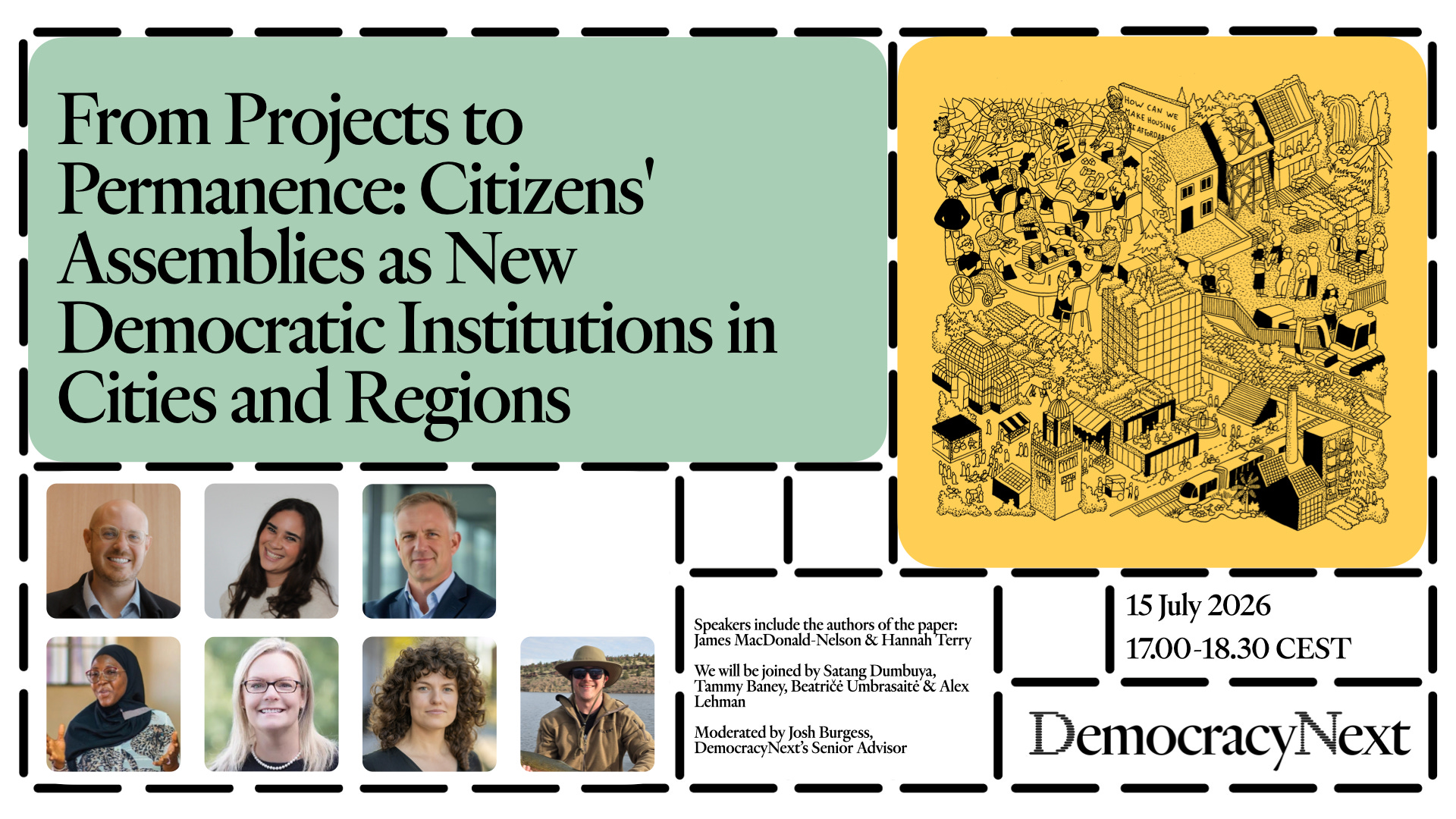
In this DemocracyNext webinar, we launch From Projects to Permanence: Citizens’ Assemblies as New Democratic Institutions in Cities and Regions, a paper reflecting on the lessons from DemocracyNext’s Cities Programme - our experience advising two cities and two regions across three continents: Esch-sur-Alzette, Vilnius, Kerewan, and Deschutes County, Central Oregon. We make the case for approaching citizens’ assemblies not as one-off events dependent on political will at a moment in time, but as new institutions to which power can be shifted. Doing so, we argue, requires a completely different mindset. It needs to be approached like a marathon, not a sprint.
The paper offers honest reflections on what went well, the challenges encountered, and what could have been done differently. What does it take to make a single assembly the beginning of something permanent?
What we’ll explore
What approaching an assembly with the ambition to institutionalise from the start looks like in practice
Lessons from four diverse contexts across three continents
The role of ecosystems, capacity building, and network weaving in sustaining democratic infrastructure
Recommendations for public servants, elected officials, practitioners, and funders
Speakers
James MacDonald-Nelson, Cities Programme Lead, DemocracyNext
James is a designer with degrees in landscape architecture, urbanism, and global development studies. At DemocracyNext, James is responsible for all things cities-related. This includes managing collaborations with cities around the world who have partnered with DemNext to broaden and deepen citizen participation and deliberation in urban planning decision-making processes - with citizens’ assemblies playing a central role.
Hannah Terry, Cities Programme Coordinator, DemocracyNext
Hannah enjoys working at the intersection of research and practice, translating knowledge into action. At DemocracyNext she worked on the cities programme, as well as, more recently, the more-than-human-inclusion into decision making portfolio. She brings experience in communications and project management from her work with NGOs and government institutions across the United States, Europe, and Africa.
Satang Dumbuya, Assembly Facilitator, The Gambia
Satang is a social justice activist focused on promoting gender equity and youth empowerment. Over the last five years, she has contributed in training over 4,000 young people on SGBV, life skills, arts, civic education and democracy across all regions in The Gambia. Nationally, Satang is recognised as a human rights activist working with and for people across all sectors. She believes that no meaningful development can take place without the empowerment, involvement and participation of young people and women.
Tammy Baney, Executive Director of the Central Oregon Intergovernmental Council (COIC)
Tammy leads regional collaboration in transportation, workforce development, economic development, natural resources, and community resilience. She also serves as Chair of the Board of Directors for SAIF Corporation, Oregon’s not-for-profit workers’ compensation insurance company. A former Deschutes County Commissioner, Tammy previously chaired both the Oregon Transportation Commission and the Oregon Housing Stability Council and serves as the Governor-appointed Convener of the Central Oregon Regional Solutions Advisory Committee. She is recognised for building partnerships that strengthen communities, improve public systems, and expand economic opportunity across Oregon.
Beatričė Umbrasaitė, Advisor to the Chief Architect at Vilnius City Municipality
Beatričė is a communications creative and facilitator working in the fields of participation, social innovation, and placemaking, she focuses on strengthening participatory urban development by fostering meaningful dialogue between citizens and key stakeholders, drawing on her experience co-founding the urban community garden Idėjų lysvė, co-authoring a practical guide on citizen participation in public space design, and designing and facilitating community engagement processes.
Alex Lehman, Delegate in the Deschutes Civic Assembly
”My name is Alex Lehman. I am a born and raised Oregonian, and I currently work for Nosler as a shift lead in bullet production. I have always wanted to be more involved with my local community, and 2 years ago I was given an opportunity by being a delegate in the Deschutes Civic Assembly on Youth Homelessness. Since then, I have continued to stay engaged and I am currently serving as an active member of COCAP’s Steering Committee. I grew up in Bend hunting, fishing, and camping. I love the outdoors, and I am passionate about getting people off their screens and bringing them together to strengthen our communities instead of dividing them.”
Moderated by Josh Burgess, Senior Advisor - USA Program, DemocracyNext
Josh is a Senior Advisor for USA Programs at DemNext and Managing Director at the Global Development Incubator, where he leads a portfolio of initiatives reimagining democracy in a changing world. He’s a social entrepreneur, board director, and leadership mentor to startups, governments, and nonprofits around the globe. Josh served as a Colonel in the U.S. Air Force as a special operations pilot and international affairs strategist. Most recently, he founded the Central Oregon Civic Action Project (COCAP), a public private partnership strengthening vibrant communities through deliberative democracy. He also serves as Board President for REACT DC, a refugee resettlement non-profit in the U.S.
This event is for:
Public servants and elected city officials interested in implementing citizens’ assemblies with the ambition to institutionalise
Advisors and senior administrators working on democratic innovation in cities and regions
Practitioners who want to approach citizens’ assemblies with a marathon mindset
Funders looking to invest in deliberative democracy beyond one-off processes
Researchers and students of local democracy, participatory governance, and democratic institution-building
Events

💪 Deliberative Muscles & AI: Thursday 9 July, 17:00-18:30 CEST
How can deliberative technology strengthen citizens’ democratic capacities to deliberate? This is the question authors Claudia Chwalisz, Sammy McKinney, Jorim Theuns, and Eugene Yi have been considering in our latest paper: “Deliberative Muscles & AI”. We will also be joined by Lisa Gutermuth, Senior Program Officer, Mozilla Foundation, Maggie Hughes, CEO & Co-founder, Convoca, and Mauricio Mejia, advisor on democratic change.
On the radar
🗳️ Anand Gopal and Ben Burgis were interviewed for The Jacobin on the subject of sortition and what it would take to achieve a truly democratic society.
📖 The Journal of Democracy July issue is free to read until 31 July. Justin Gest writes about “the democratic drain”, and there’s a piece on why “freedom philanthropy” - funding dissidents and civil society abroad - is so important for global democracy.
🩺 Ontario Nurses’ Association (ONA), Canada’s largest nurses’ union with over 68,000 members, convened a Members’ Assembly this March - randomly selecting 30 nurses and allied health professionals from across the province using a civic lottery to help shape ONA’s next strategic plan.